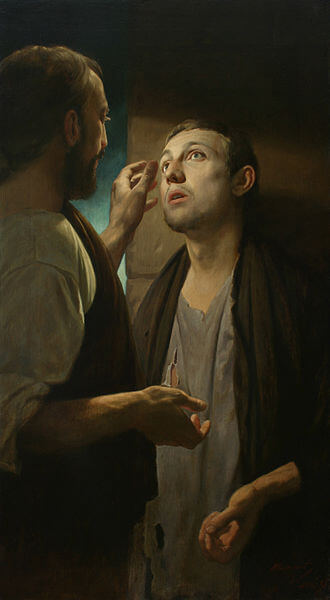
blind man
From Blindness to True Sight: Discovering God in Suffering
4th Sunday of Lent
Fr. Joonbin Lim
Preached: March 15, 2026
Today, through this Gospel, I would like to reflect on two things: first, what suffering is; and second, what it means to see.
When we encounter someone who is sick or suffering, what is usually the first thought that comes to mind? For most people, it is probably the desire to help. But today’s Gospel begins with a very different question. People look at the man born blind, and before they notice his suffering, they ask, “Who sinned?”
In the thinking of many rabbis at that time, illness and disability were often understood as the result of sin. But Jesus rejects that way of seeing. He heals the man born blind, and because of this, conflict arises with the Pharisees and others among the Jews.
Their argument is clear: if Jesus healed on the Sabbath, then He broke the Law, and if He broke the Law, He cannot be the Messiah. Yet today’s Gospel invites us to go deeper.
What, then, is suffering? Like the man born blind, some people carry great suffering from the very beginning of life. And as we go through life, we encounter many kinds of suffering beyond our expectations and understanding: illness, loss, war, disaster, unjust tears, and pains that are difficult to explain.
In Buddhism, life is sometimes described as a sea of suffering. In a certain sense, we can understand why. We rarely see a baby born laughing. Every child enters the world crying. From the moment a child leaves the warmth of the mother’s womb and enters the world, that child has already entered the reality of suffering.
I have asked this question many times myself. When life becomes painful, when I face suffering I cannot understand, when innocent people die in war and disaster, I find myself asking: Why does God allow such things? Today’s Gospel gives us an important light.
Jesus says in John 9:3: “Neither this man nor his parents sinned; he was born blind so that the works of God might be revealed in him.” This does not mean that suffering itself is good, nor that God deliberately causes people to suffer.
Rather, Jesus rejects the idea that suffering is a sign of sin. He shows us that even in the place of suffering, the mercy of God and the work of salvation can be revealed. Just as darkness covered the deep before creation, the darkness of suffering still surrounds the human condition.
Humanity has long tried to explain its origin and meaning, but no myth, philosophy, or human wisdom has fully explained it. Yet light belongs entirely to God, and that light is revealed in the Word of God. God is not One who curses, crushes, or destroys us.
He is the One who seeks the suffering, embraces the wounded, and raises up those who are burdened and broken. In Jesus, we see the true face of God. In today’s Gospel, the man born blind and the Jewish authorities stand in sharp contrast.
The real blindness Jesus speaks of is not only physical. It is the blindness of those who claim to know and see, yet refuse to seek and accept the truth. The social assumption at that time was simple: if a man was born blind, he must remain blind, and therefore remain a sinner.
Because this belief was so strong, people could not even accept the reality of his healing. So in the end, the man born blind comes to see, while those who insist that they already see become the truly blind. This is spiritual blindness.
And this brings us to the second point: what does it mean to see? This Gospel is not simply the story of a blind man receiving physical sight. It asks all of us what it truly means to see. Usually, when we speak of seeing, we mean recognizing something with our eyes. But the seeing of which the Gospel speaks is much deeper than physical sight. It is not only noticing what is in front of us.
It is perceiving meaning, passing through life, and finally recognizing the truth. True seeing is not simply looking. It is seeing through experience. To see again means that something has been lived through from the depths of one’s being.
Often when we say we now see something differently, it is because we have suffered, endured, waited, and grown. The man born blind teaches us this. From the beginning of his life, he had more to endure than others. And often those who pass through many struggles come to see life more deeply. His receiving sight means more than physical healing.
By passing through the depth of suffering, he came to see the Lord anew. Our faith is like that. Faith is not simply looking at God from a distance. It is passing through life with Him. Through suffering, endurance, waiting, and grace, our eyes are opened.
And when we truly live, endure, and pass through life, we begin to see the Lord.