covenant

To the Empire’s Boundaries….And Beyond!

By http://www.moviestillsdb.com/movies/toy-story-3-i435761/20c11d67, Fair use, https://en.wikipedia.org/w/index.php?curid=44184427
2nd Sunday Of Lent – Year C
Fr. Peter Robinson
Luke 9:28-36
Do you remember the famed Buzz Lightyear and his battle cry in Toy Story? “To infinity and beyond” It’s funny, because there is no “beyond” beyond infinity, right? Now, I don’t often give titles to my homilies, but this one could be called: “To the Empire’s boundaries … and beyond”. Let me show you what I mean.
In our Gospel reading today, St. Luke stresses that Jesus went up the mountain to pray. Here is something interesting ⇢ Luke frequently stresses Jesus’ constant need for prayer. Jesus was a man whose life was permeated with prayer. In fact, when you think about it, many of Luke’s parables are about prayer
For instance, consider these examples …
Think of the poor widow, who keeps pleading with the unjust judge until she receives her request
Or the Pharisee and the tax-collector – because the Pharisee is filled with pride, God does not hear his prayer. And yet, the Pharisee is the religious conservative in this story — his theology is spot on. Whereas the tax-collector? — he is broken by the financial wrongs he has done to others, and God hears his prayer!
Prayer is important to St. Luke.
So, we find Jesus going up a mountain to pray. Then something absolutely extraordinary happens. While Jesus was praying his face changes in appearance, and his clothing becomes dazzling white. Then, Luke describes that Jesus converses with Moses and Elijah (two of the greatest OT figures). Moses represents the Old Testament law, and Elijah represents the prophets. They talk about Jesus’ coming journey up to Jerusalem. That journey will culminate in Holy Week, in which Jesus will offer himself as the Lamb of God, who takes away the sins of the world.
You see, a week earlier Jesus had said to his disciples: Truly I say to you, there are some standing here who will not taste death until they see the kingdom of God (v. 27). Now, a few privileged disciples get a precious glimpse of the eternal glory in which Jesus now dwells However, the three disciples also hear the voice of God insisting that they must listen to Jesus’ message
And what does Jesus teach them? He teaches them that suffering is the way to glory. He calls on them to give up their own lives in order to gain their lives. In other words, they are to take up their own crosses, and to follow him
Not only did the disciples struggle to hear this message, it is possible that (like us) they did not want to hear this message. That suffering and the cross … come before the glory. What I find amazing is how literally Jesus’ disciples came to believe this teaching (except for Judas, of course) … and how they put this message into practice.
Now, St. Peter and St. Paul gave their lives for Christ in Rome, in the very heart of the Roman Empire. Yet in the coming decades, the other Apostles would travel with the gospel to the edges of the Roman Empire … and even beyond. On those borders, as best we know, all of Jesus’ Apostles died a martyr’s death (except for St. John). They died on the edges of the Roman Empire — or beyond.
North, south, east and west … Jesus’ Apostles travelled with God’s message to their known world. To tell that world God’s message that Peter, James, and John had seen and heard on the Mount of Transfiguration. What was that message? This is my Son, my Chosen; listen to him!
………..
* See John Nolland, Luke 9:21–18:34 (vol. 35B; Word Biblical Commentary; Dallas: Word, Incorporated, 1993), 502
Genesis 15:5-12,17-18
Now, we have a graphic description of the kind of sacrifice that Jesus will make on the cross, from a story about Abraham in Genesis (15).
Our lectionary has deliberately paired these two stories together. Roughly 2000 years before the time of Christ, God made a pact with Abraham, of lasting protection for Abraham and his descendants. This pact (or covenant) was in the form of an ancient sacred sacrifice … a kind of rite known from other ancient Near Eastern sources, by the way (not just from the Bible)
The offerings of Abraham are cut in half, and (THIS IS IMPORTANT) it is God who makes the pact, by passing between the halves of the sacrifices. God uses this sacred symbol to declare his faithfulness to his covenant. God, Abraham — and his descendants — are now in a relationship that has serious and long-lasting consequences.
<[>You see, in the ancient Near Eastern world, such covenants were frequently made between two equals, or between overlord and vassal. But there is no historical record of such a covenant being made between a deity and a human being. Yet the awesome presence of God here passes between the halves of the offerings.
Notice that Abraham cannot impose conditions on God; God is the greater party. Nor can Abraham do anything to earn or justify this promise; the initiative is God’s. Abraham can only trust in God. For Abraham himself remains a nomad, with no settled territory to call his own
Notice, then, the similarity between Abraham’s sacrifice and the words you have spoken so often at the midpoint of the Mass. Just before the priest says the Prayer over the Offerings, he calls out: Pray, brothers and sisters, that my sacrifice and yours may be acceptable to God, the Almighty Father . And your response reflects the attitude of Abraham’s heart 4000 years ago: May the Lord accept the sacrifice at your hands for the praise and glory of his name, for our good and the good of all his holy Church.
This sacrifice of the Mass, this New Covenant (for us, the New Israel), if received in faith, like Abraham …
- Cleanses us of ALL our faults
- It makes us holy in body and mind
- And it is preparing us already for our celebration of Easter in mid-April
It’s In You To Give!
Solemnity of the Most Holy Body & Blood of Christ (Corpus Christi)
Deacon Tom Vert
Preached: June 2, 2024
It’s in you to give!
You may remember this slogan from Canadian Blood Services that was used to encourage blood donors.
Blood is true a life-giving donation, with platelets and red blood cells and everything needed to save the life of another person.
Blood as a giver of life has been in cultures for thousands of years, like a blood oath, blood brothers, and as a bond to seal covenants.
Blood truly gives life, and we see it in all four readings today!
Moses sprinkles blood on the altar and on the people, as a perpetual seal of the covenant of the ten commandments between God and the Israelite nation.
In the psalm, we hear of the cup of salvation poured out for us, and we can picture the same pouring of the blood on the altar by the chief priest and then the foreshadowing of Christ pouring out his blood and water from his side on the cross for us.
The 2nd reading then reinforces this saying “not with the blood of goats and calves, but with his own blood, thus obtaining eternal redemption.”
Christ’s sacrifice was once and for all, he entered the heavenly sanctuary and opened the gates of heaven for us, despite our unworthiness!
And finally in the gospel, we see the gift of the Eucharist, the Body and Blood of Christ, given to us on the night of the Last Supper.
These two phrases “”Take it; this is my body,” and “This is my blood of the covenant,” have been spoken and celebrated in the house churches, cathedrals, and parishes for over 2000 years and our priest will proclaim them again at today’s celebration.
This is the new covenant we celebrate today!
The old covenant was based on the law written in the book, in the people keeping the law, and God as the judge of whether they did.
But the new covenant is based on sacrificial love of Christ, with God looking at what his Son did for his “brothers and sisters” and not on our scorecard of religious performance.
Christ shows us how much God loves us and wants to be in relationship with us, by offering himself up for each of us, in spite of the fact that if we relied on our own efforts, we could never deserve it.
This loving relationship takes on its full meaning when we receive the Eucharist in our hands, and we consume it, as we truly have Christ in us.
And, if Christ is in us, and we have been told like the apostles, as Christians, to “go out”, then truly the Eucharist is in us to give!
The Christian journey has never been one in which we hoard the gift for ourselves!
If we look at the shrine to St. Catherine of Siena on the way out of the church, we see this message so clearly.
On the left, the first image is of St. Catherine in prayer, while the two images on the right on her helping the poor and the sick.
Her prayer life, her reception of the Eucharist gave her the strength and the grace to go forward and witness in the world! She gave of what she had, and what she had was God’s strength and the power of the Holy Spirit in her!
We are so blessed to be able to receive the Eucharist every day if we want to, as it is not a prize to be won by perfect performance, but it is food for the journey and medicine for the sick!
It is the life-giving covenant of the Body and Blood of our Lord, and this is what we celebrate in this feast day today!
We have the same Holy Spirit, the same Eucharist as St. Catherine did, and so we are to go out into the world and change it little by little as the Body of Christ.
We go forward in the little acts of kindness and love each day in the place that God has planted us!
So today, after you receive the Eucharist, and you go back to your pew, maybe say a small prayer “God, where do you want to send me today, for you truly are in me to give!”

Do You Reflect The Good News?

First Sunday Of Lent
Fr. Mark Gatto
Preached: February 18, 2024
When people experience your Catholic faith, in your words, in your actions, in your life, do they experience it as good news? When people experience our Catholic Church, including our local parish, do they experience good news? In the Gospel of Mark, it says that Jesus came proclaiming the good news of God.
What was this good news? In Jesus, God was speaking a word of love to humanity. God was saying, I love you, I forgive you. God was saying that the will of God is for our salvation, not our condemnation. In Jesus, many people for the first time were able to believe that they could be accepted by God, embraced by God.
Especially the poor, the tax collectors, women, the lepers, and so many others who had been convinced that they were not worthy, that they were not welcome with God. Now, in Jesus they were hearing the incredible good news that, yes, God did want to receive them and they too could be welcomed in the Kingdom of God.
Imagine always being told that you were impure, not worthy, not loved by God. Then you discover for the first time that it is possible for you to be received and embraced and loved by God.
One key word to understand the good news is the word Covenant. In our first reading today, from the Book of Genesis, we see the Covenant established after the Great Flood between God and Noah and all living creatures. Marked by the sign of a rainbow in the sky. Later on we will see other Covenants formed by God with Abraham and with Moses on Mount Sinai. Finally, in Jesus, God comes to reveal the eternal Covenant binding God to us for eternity in unconditional love and mercy.
We express this Covenant every time we celebrate the Eucharist. We hear the words of Jesus at the Last Supper, “this is the chalice of my blood, the blood of the new and eternal covenant.” We use this word Covenant to describe what Christian Marriage is meant to be. The best definition of Covenant I have heard is simple, “Covenant is the promise to remain.” This is the good news, God’s promise to remain with us in life and in death with an unconditional love for eternity.
First preaching of Jesus is “repent and believe in the good news.” People struggle to believe in the good news of the eternal love of God. Struggle to believe in the covenant of God promising to remain and who desires our salvation and not condemnation. Many of us find it difficult to believe this good news. We feel we are not worthy, that we not good enough. But, Jesus proclaimed good news, revealed the great covenant, the promise to remain by a God who longs for us and loves us.
Our challenge as Catholics, as disciples of Jesus, is to live and speak and be with others in a way that will help them to believe in the good news of God’s Covenant in Jesus. That God embraces them. Do people experience this good news in their encounter with the Church, in their encounter with you?
I saw this quote by a minister recently. He said, “Our Christianity should sound like this: ‘the world is full of neighbours to be understood and loved,’ not ‘the world is full of enemies to be feared and conquered.’” How we live our faith, the way we speak about our faith, the way we treat others, does it reflect good news?
Reflect good news in your Catholic faith. Speak to people, speak about people, be with people, in a way that reflects this undying love of God who promises to remain with us.
Believe the good news brought by Jesus, that God is in love with you. Then help others to believe that God is in love with them.

The Promise To Remain

Holy Thursday
Fr. Mark Gatto
Preached: April 14, 2022
What is one of the most important words in the Catholic faith?
Covenant. But it is also one that many do not really think about often. It is actually a concept rooted in our Jewish heritage, found throughout the Old Testament. Throughout salvation history, there has been a series of covenants.
After Noah’s Ark there was the covenant established by God with all humanity symbolized in the rainbow. Then there was the covenant with Abraham, symbolized by circumcision. God establishing a relationship with a particular people.
Later there was the covenant established through Moses. Rooted in the Law. Celebrated in the yearly Passover meal that Jesus celebrated at his Last Supper.
Covenant is the word we use to describe the marriage of a Catholic in the church. Spouses make the vows to be faithful “in good times and in bad, in sickness and in health.”
As we celebrate the Eucharist, we are celebrating the New Covenant, listen how often we hear that word, Covenant.
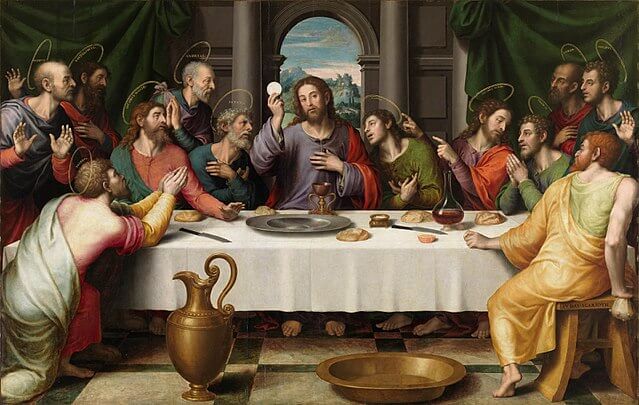
The best definition of Covenant that I have heard is Covenant is “the promise to remain.” In Jesus, God came among us to make it clear that God will remain with us. That even in our death, God remains with us. Every time we celebrate the Eucharist, we are recalling this Covenant, God’s promise to remain. In simple bread and wine, we have the Real Presence of Jesus.
In Jesus, God is saying to you and to me, I will remain with you, I will not abandon you. What a great gift to have someone who promises to remain with us in good and bad.
At this Mass of the Lord’s Supper on Holy Thursday we always listen to the Last Supper account from the Gospel of John. It is very different from the other Gospels. The main focus is Jesus getting down to wash the feet of his disciples. In fact, perhaps the best symbol of Christianity is the towel. A model of humble service.
Within our families, within our church, the towel of humble service is the key to healthy families and a healthy church. Sometimes in cartoons we see God sending down lightening bolts to strike the evil down. Sometimes someone who has been away from church for a long time will joke about being struck by lightning. But, a truer image of God is God getting down on his knees with a towel to wash away our hurts and pains.
Our world promotes domination, power over others, it is seen time and again in wars between nations, at this time with Russia invading the Ukraine. Within families we also see this when violence and force is used to have control over a spouse.
The way of Jesus is reflected in Holy Thursday, the simple towel of humble service. You could call this the Holy Thursday revolution. Imagine what a difference it would make if parents and spouses held towels instead of wanting control and domination. Imagine if priests held towels of humble service rather than control and domination. Imagine if humanity embraced the humble service of the towel rather than the way of force and violence.
On this Holy Thursday, we celebrate the new covenant, God’s promise to remain. Then we are offered the towel of humble service to guide all of our relationships.
One of the greatest gifts you can offer to another person, is what God offers to us, the promise to remain, in good and bad.