Emmaus
When the Mass Comes Alive: Walking with Jesus to Emmaus
3rd Sunday of Easter
Fr. Mark Gatto
Preached: April 19, 2026
What do you appreciate most about the Catholic Mass or Eucharist?
For over 2000 years, Christians have gathered to celebrate the Eucharist. In a variety of ways and languages. All rooted back to the Last Supper when Jesus commanded, “Do this in memory of me.” Through the centuries it has changed and taken different forms.
Initially with the first disciples in Aramaic. Then, in the first three centuries, the primary language was Greek, still see those Greek roots when we sing the Kyrie Eleison. Next, the language of the Roman Empire, Latin, became the primary language of the Mass. After Vatican Council II, the church embraced the vernacular in order that all people could understand and participate in the prayers of the Mass.This recognized that the church had become a truly world church.
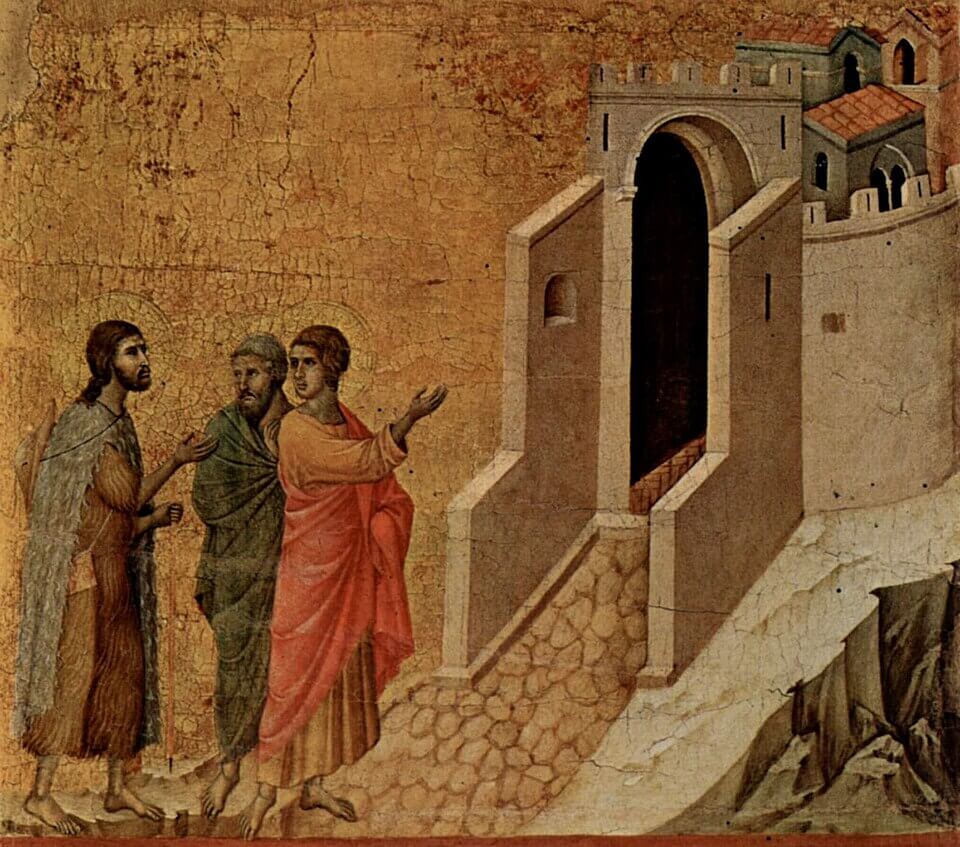
If we wonder what the Mass looked like in the beginnings of the church, today’s Gospel would be a good place to look. We heard the resurrection story of Jesus appearing to the two disciples on the Road to Emmaus. In this story, we have a picture of what the Mass looked like in the very first decades of Christianity. Some things we see have been constant throughout the two thousand years and continues to be found when we celebrate the Eucharist today.
First, we see the disciples walking along, discouraged, sad, grieving. Jesus simply walks beside them and listens to them. Also, when we come to Mass, Jesus wants to listen to us. What are we feeling, what is happening in our life, are we grieving or struggling in some way? Bring your life and its struggles with you when we come to Mass. Jesus wants to hear you and walk with you.
Second, it says that Jesus interpreted to them all the things about himself in the scriptures, beginning with Moses and all the prophets. This describes a Liturgy of the Word, something found in every Mass for 2000 years and is one of the two foundations of the Mass in every age.
Third, the disciples invite him,“Stay with us” and Jesus joins them at the table for a meal. It says that Jesus “took bread, blessed and broke it, and gave it to them.” The same words from the Last Supper, from the Miracle of the Loaves and still heard today during the Consecration at each Mass. These words were obviously heard when Christians gathered for the Eucharist even in the first decades after Christ.
Fourth, they go out and proclaim to the others their experience of the Risen Lord Jesus. At the end of each Mass the presider sends us out to proclaim the Gospel and live as the body of Christ in the world. One dismissal in our Mass says, “Go and announce the Gospel of the Lord.”
I encourage you to reflect on this account from Luke’s Gospel of the story of Jesus meeting the disciples on the road to Emmaus. See how it provides an outline for the way the Eucharist was celebrated in the very first decades of Christianity. Also, how it describes the outline of the Mass that we have today. We see the two foundations of each Mass for the past two thousand years and continuing today. A Liturgy of the Word and Liturgy of the Eucharist.
This gives us some guidance in how to prepare for the Mass and to enter into it more fully. When the two disciples reflected on their experience, they said, “were not our hearts burning within us while he was talking to us on the road, while he was opening the Scriptures to us.” We priests are to prepare and preach so that our homilies help our hearts to burn within us. But, each of you should prepare for Mass by praying with and studying the readings for the Sunday Mass so that you are able to hear Jesus speaking to you and that your hearts will burn within you.
Then the two disciples tell the others about how Jesus was “made known to them in the breaking of the bread.” In fact, one of the first ways the early church called the Mass was “the breaking of the bread.” They had to invite Jesus in to the table with them, urging him strongly, “Stay with us.” Each time you make the effort to come out to be here for Mass, you are praying to Jesus just by coming here, “Stay with us.”
What we are doing now is what Christians have done for 2000 years. Sometimes called the “breaking of the bread”, or the Eucharist, or the Mass. Always including a Liturgy of the Word when we listen to Jesus explaining the scriptures to us and a Liturgy of the Eucharist when the Risen Lord Jesus is in our presence through the “breaking of the bread.” Each time we gather here we are like those two disciples on the road to Emmaus. Today we have invited the Risen Lord Jesus, “Stay with us.” We are gathered around this table with Jesus who will take the bread, bless it, break it and give it out to us.