eternal life
May Your Love Be Upon Us, O Lord, As We Place All Our Hope In You
2nd Sunday of Lent – Year A
Deacon Tom Vert
Preached: March 1, 2026
“May your love be upon us, O Lord, as we place all our hope in you.”
So, we need to ask, “For what do Christians hope? People look at us and ask, “Why are Christians so hopeful and joy filled, even when they are challenged and struggling with all the things going on in this world”? How do they still have hope when everything seems to be negative? What vision do they cling to that gives them peace and joy in the storms of life?
This question could be one that was asked of Peter, James, John and the other apostles after Jesus ascended into heaven and the Romans and Jewish authorities were both persecuting them aggressively, and yet we know they went out a proclaimed the gospel message of good news continuously for all to hear.
The three key apostles I am sure would have had a vision of hope in Jesus glorified in heaven as they saw with their own eyes on the mountain in Israel, shining brighter than any white they had ever seen, and the voice of the Father ringing in their ears “This is my beloved Son, with whom I am well pleased; listen to him.”
The vision of heaven which Christ promised, the gift of eternal life, is one that should also be a motivator for each of us as we go through our own struggles and see the chaos in the world today.
For what do we hope…I would argue that we Christians hope to encounter and be transformed by Christ’s self-sacrificing love both here in the present world and eternally in heaven after our death.
This generates our spiritual energy and allows us to give a living witness of God’s love in the world and by this witness, as people see our lives, brings others into God’s loving embrace.
The Catechism tells us that “Hope is the theological virtue by which we desire the kingdom of heaven and eternal life as our happiness…and we hope in the glory of heaven promised by God to those who love him and do his will”
This definition is good, however, it doesn’t tell us what eternity will be like so we can envision the goal, and it doesn’t tell us that if we embrace this vision, how should we live now when humbly accepting this great gift?
Now, let us start with the goal…what we are striving for and what life will be like in eternal glory, that we call heaven. And heaven is what we truly hope for St. Paul tells us, that “If we have hoped in Christ only in this life, we are of all people most to be pitied.”
The best place to start is the mystery of heaven’s greatness that St. Paul tells us about “No eye has seen, no ear has heard, and no mind has imagined what God has prepared for those who love him.”
People can agree that it will be amazing, so the next question about heaven that normally comes up is what will we be like? Will it be just our souls or our bodies or some combination of these.
The beautiful image St. Paul gives us in the first letter to the Corinthians is of a seed which is sown and then grows into a stalk of wheat. “The image of the seed is an image of radical transformation” that continues from what was before in the seed but emerges as something entirely new and spectacular!
We are also told by Paul that “the new body will be everlasting, glorious, constituted in power, and above all a spiritual body”. These images give us hope for something much better than the present, but we are not exactly sure what!
So, there is a heaven, and we will have transformed spiritual bodies with our souls! If we have this knowledge of Christ’ promise for us, and the joy that our eternal life is foreshadowed by Jesus’ own Resurrection, then we should have hope and as Pope Benedict says, “The one who has hope lives differently; the one who hopes has been granted the gift of a new life”
When we truly live this way, as “agents of love” in the world, we are a living witness of God’s love in the world and by this witness we bring others into God’s loving embrace and thereby bring the kingdom of God into the world here and now not just after we die.
We are the hands and feet of God in the world today and we as Christians are called to accept this mission of love in the world, and we know we can do it as we sang in the psalm “May your love be upon us, O Lord, as we place all our hope in you.”

Remembering With Hope: The Gift of Catholic Funeral Rites
All Souls Day 2025
Fr. Mark Gatto
Preached: November 2, 2025
I was baptized as a baby and have been Catholic all my life. I was ordained a priest in 1990, so I have been a Catholic priest for 35 years. My entire life has been immersed in the Catholic faith. This is a great gift, but it comes with a danger. Familiarity can sometimes lead to taking things for granted.
For those of us who have always been Catholic, it is easy to overlook some of the rich blessings of our faith. Recently, I have been reflecting on one particular area we might take for granted: our Catholic Funeral Rites. They are a profound and beautiful gift.
All Souls Day and the Christian View of Death
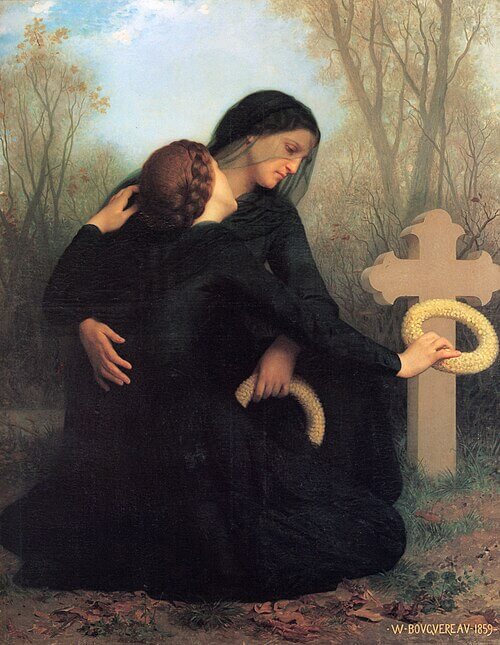
This year, November 2 falls on a Sunday, so the Feast of All Souls is celebrated at our Sunday Masses. It is a moment to reflect on death, life after death, and the promise of resurrection. We remember and pray for our loved ones who have died and reflect on the hope we have in Christ.
Lex Orandi, Lex Credendi
In the Catholic tradition, there is a phrase in Latin: “Lex Orandi, Lex Credendi.” It means, “The law of prayer is the law of belief.”
In other words, the way we pray reveals what we believe. By simply participating in Mass, we absorb the Catholic faith. So if we want to understand what we believe about death and eternal life, we look at how we pray in our funeral liturgies.
Beyond “Celebration of Life”
Many Christian communities, and certainly secular society, do not have rich rituals around death. Often there is only a celebration of life or eulogies that speak about a person’s past. While meaningful, these moments often stop at memory. There may be no proclamation of hope, no language of eternal life, and no encounter with the God who conquers death.
Catholic Funeral Rites, by contrast, satisfy the deepest longing of the human heart: the desire for meaning, mercy, and hope in the face of death.
The Funeral Liturgy: Signs of Christian Hope
At a Catholic Funeral Mass, you will see the Easter Candle beside the casket or urn, reminding us of baptism and the light of Christ that no darkness can overcome.
When a casket arrives at the church entrance, it is covered with a white pall, symbolizing the baptismal garment. As the pall is placed, the priest proclaims:
“On the day of his Baptism, N. was welcomed into the Church, given new life in Christ, and clothed with the garment of salvation. Today we commend our brother to the mercy of God and pray that the promise made to him in Baptism will be fulfilled.”
In this moment we remember that baptism begins our journey toward eternal life, and death is not its end, but its completion.
Listening to the Word of God
At every funeral Mass, we celebrate the Liturgy of the Word, just as we do at every sacrament. We listen to Scripture chosen to comfort, guide, and anchor us in faith. These readings proclaim the promise of Christ and remind us where our true hope lies.
Life Is Changed, Not Ended
During the Eucharistic Prayer, listen carefully to the prayers offered for the deceased. One of the Prefaces for funerals beautifully expresses our belief:
“For your faithful, Lord, life is changed, not ended. An eternal dwelling is made ready for them in heaven.”
The Eucharist nourishes us on our journey to eternal life, and at a funeral Mass, that meaning becomes especially clear.
Final Commendation and Committal
After Communion, we pray the Final Commendation. The body or ashes are sprinkled with holy water and honored with incense. These gestures express our deep reverence for the dignity of the person who has died.
The last prayer before burial expresses our hope:
Priest: “Eternal rest grant unto her, O Lord.”
People: “And let perpetual light shine upon her.”
Compassion and Resurrection
In our Gospel today, Jesus meets a grieving widow whose only son has died. Scripture tells us Jesus had compassion on her and said, “Do not weep.” Then he called to her son, “Rise.”
Every Catholic funeral echoes that same promise. Christ looks upon the grieving with compassion, and to the one who has died he speaks, “Rise.”
We Mourn With Hope
As Catholics, we mourn, but not like those who have no hope. In our funeral rites, we proclaim that death is not the end. We entrust our loved ones to God’s mercy and light, confident in the promise of eternal life.
Death is real, yet so is resurrection.
Our Catholic Funeral Rites remind us, with gentle strength and deep faith:
Life is changed, not ended.

Do You Own Your Money Or Does Money Own You?
28th Sunday In Ordinary Time
Fr. Mark Gatto
Preached: October 10, 2021
 When is the last time that you did a good examination of conscience? In the past this was something Catholics did regularly to prepare for Confession. They would do an examination of conscience to prepare for what they were going to confess in the Sacrament of Reconciliation. But a good and honest self examination is important if we are going to be wise and live life in a good meaningful way. What kind of questions would you include in an examination of conscience?
One thing that is usually missing in many examinations of conscience, at least in my experience, are questions about my use of money. But, money is clearly something extremely important in our lives and therefore our attitude toward money and decisions about money are crucial in our being a disciple of Jesus.
The man in today’s Gospel runs to Jesus and asks “What must I do to inherit eternal life?” He is indirectly asking Jesus to provide him with an examination of conscience that will guide him in leading a good and holy life. Jesus begins where most of our basic examinations of conscience begin, with the Ten Commandments. It seems that this man had been trying to live a good life and follow the commandments. Then Jesus pushes him further, “go sell what you own, give the money to the poor.… then come follow me.” The man was shocked, he went away grieving, went away sad. He had many possessions. He was not free, he was clinging to his possessions, he was trapped by them. He did not own his possessions, his possessions owned him.
A good examination of conscience should challenge us to reflect on our attitude to our possessions and money.
- Do we own our possessions and money or do they own us?
- Does greed and clinging to these possessions and money dominate all of our decisions?
- If someone was to see how we use our money, what would it say about what really matters to us?
- Is fighting over money or possessions leading to divisions within family, with friends?
- What do we treasure most in our life? If there was a fire and we had to leave our house quickly, what would we choose to take with us?
When we are making decisions about how we are using our money, do we pray about it? Do we ask the Holy Spirit to guide us in making these decisions?
In the news this past week, there is the report from the Pandora Papers. It is a leak of information about tax havens and places where money is kept offshore to hide it for tax purposes or criminal reasons. Billionaires, extremely wealthy people, world leaders find ways to hide their wealth to insure they do not need to pay taxes. Sometimes it is illegal, but primarily it is utterly unethical.
In these cases, wealth and money has become more important than anything else. The result of these tax havens is that trillions of dollars are not available to countries to support society in terms of health care, education, supports for housing, the poor and so on. The same people who do this are those who complain about governments spending money on the poor, on the disabled, on health care for everyone, on climate change.
Our decisions and attitude towards money is not just an individual matter. As a society, as a human family in this world, we need conversion, we need to change attitudes. We need to bring in policy that does not allow the richest among us to exploit the system so that many are left without basics for a dignified life. Greed, that sees money as the most important thing, results in great harm to human society. It is now leading to great harm to our planet which is our common home.
All of us should do a good examination of conscience which includes looking at my attitude towards money and wealth, that reviews how I use my money and wealth. Like the man in today’s Gospel, Jesus may be challenging us to look at this aspect of our life. Jesus loves us and does not want us to leave grieving and sad like that man. Jesus wants us to remain free and not to be possessed by our money and possessions.

Are You Saying Yes To God’s Invitation?

28th Sunday In Ordinary Time
Fr. Mark Gatto
Preached: October 11, 2020
Have you ever invited someone for a dinner at your home and they said that they are coming and you spend lots of time getting things set up. You cook all day, get the table prepared and then at the last moment they call to cancel? All that preparation and excitement of hosting them. It is very disappointing and upsetting.
Well, God, the Creator of the Universe, came to us in Jesus, to invite us to a great banquet. In Jesus, God has invited all human beings to the banquet of eternal life. This gathering will be at home in the Holy Trinity.
Our first reading today is from the Prophet Isaiah, it is a reading that is often used at funerals. The Prophet Isaiah offers a vision of God’s plan for us, using the image of a great banquet. God hosts a feast of rich food, well aged wines. Death will be swallowed up forever and tears will be wiped away from all faces. Imagine being invited to the great banquet of our God to celebrate forever.
But, in the Gospel today, Jesus tells a parable about a king inviting people to a wedding banquet. Some say no, others say they are too busy, others have their business to take care of, others reject even those who bring the invitation.
Imagine being invited to eternal life and saying, “no, I am not interested.” “No, I am too busy doing important things here right now.”
Imagine being invited to be a beloved child of God, to live forever in the embrace of the Holy Trinity and saying, “no thanks.”
We do this by our decisions, by our actions, by our way of life. Does my way of life, do my decisions and priorities, say yes to the invitation to the wedding feast prepared for us by God?
A good examination of conscience for each of us is to ask myself this question: By my life right now, by my decisions, by my priorities, am I accepting or rejecting the invitation to the great banquet prepared for us by God?
How am I treating the people in my life? Do I spend time with Jesus now in prayer and sacraments? Do I share with others in our world, showing a concern that no one is left out? By my life and faith am I dressed for the banquet that God has invited us to attend?
Our God, came to us in Jesus, to give to each one of us an invitation to the great banquet of eternal life. At our baptism, we received that invitation personally. Now each of us need to accept that invitation from God by our life, by our decisions, by our priorities. Are we saying yes to the invitation from God?