repent

Divisions!

3rd Sunday Ordinary Time – Year A
Fr. Mark Gatto
Preached: January 25, 2026
The Catholic Church has been here for about 2000 years. It has changed and taken many forms through those years. But, some things have been constant from the beginning. What do you think are some of those things that have remained constant these 2000 years? Perhaps none of you were thinking of what I would say has remained constant in the past 2000 years of the church. Disagreements and division.
I want to do a little walk through history. History is so important in understanding what is happening today, it is important in putting issues into context. Yet we so often forget or ignore history. This is the case in politics today, but also can be the case in looking at the church today.
So, what does the history of the church show us?
The divisions and infighting within Christianity began right from the beginning. We see it right away with the first apostles, but we really see the reality of division within the church when we read the Letters of Paul. He is constantly speaking about the need for unity and trying to overcome disagreements.
In our second reading today, we hear Paul encouraging the Corinthians to “be in agreement and that there be no divisions among you.” He speaks of the reports from some that there were quarrels among them. There were cliques among them, some saying, “I belong to Paul,” others saying, “I belong to Apollos,” and so on. Paul asks, “Has Christ been divided?”
This tendency to disagreements and divisions continues throughout church history. In the 3rd and 4th Century we see struggles over the identity of Christ. Some saw him as truly divine, but not fully human. Others that he was a great human being, but not divine. This movement was called Arianism.
There were great battles over this. The first church Council took place in 325 AD, the Council of Nicaea. In fact, Pope Leo along with other churches recalled this Council recently in the 1700 th Anniversary of that Council where the church resolved what orthodox teaching about Christ taught. We still today embrace that teaching that Jesus is truly God and truly human.
Historical and political circumstances also impact the unity of the church. The Roman Empire gradually formed into two areas, the Eastern Roman Empire and the Western Roman Empire. The church on each side developed in different ways. Gradually this led to division.
In 1054 there was an official split, each side excommunicating the other. Those churches on the East we call the Orthodox Churches, separated from the Pope and the Catholic Church. Though there were efforts to renew the unity of the church it did not take place. In those efforts we see many Eastern Rite Catholic Churches formed, Ukrainian Catholic, Coptic Catholic, Chaldean Catholic and others. They had many features of the Orthodox Churches, but returned to communion with Rome.
Later on there were struggles within the Western Church. In fact, in the time of our patron saint, St. Catherine of Siena, in the 14 th Century there was the Great Western Schism with up to 3 different Popes being declared at the same time. The papacy became exiled for about 70 years to Avignon, France. St. Catherine was one of the figures who worked hard to have the Pope return to Rome.
Later came the division within the West. It began with Martin Luther who was calling for reform of the church. This eventually led to what we call the Protestant Revolution. Gradually there were many divisions with the Protestant churches themselves leading to many different denominations. The division between East and West, Catholic and Protestant continued into the 20 th Century as separate Christian groups that did not speak to each other, did not pray together.
This was just a brief summary of the reality of divisions within the history of the church. In the 20 th Century there began an ecumenical movement trying to bring greater unity within Christianity. Protestant missionaries realized that their divisions made evangelization difficult.
Imagine in some small town in a foreign land where there were several different Christian churches fighting and competing among themselves. The Catholic Church officially embraced this ecumenical effort at Vatican Council II. One purpose of this Council was to help the Catholic Church to be an instrument of unity within Christianity.
Today, our Catholic Church is committed to Christian unity. Where in the past we would not work with or pray with other Christians, today we see these others as brothers and sisters in Christ. We are to work together to build up the unity of the Church as willed by Christ. Every Pope since the Council in the 1960’s has shared this vision of striving for unity.
But, like the past 2000 years, we still find disagreements and divisions within Christianity and within our own Catholic Church. The Church is a divine and human reality. Founded by Christ and guided by the Spirit, the Church is a divine mystery. But, it exists within history and consists of human beings.Therefore in its human reality it often falls short of the image of Christ that we are called to be. Human sin exists in the church and that includes bad decisions, selfishness, disagreements and divisions.
Today what are we called to do as Catholics? Work to overcome divisions within our own local communities. Do not focus on our disagreements. See other Christians as people we can pray with and even learn from. Within our Catholic Church, be people of communion. At each Mass we commit ourselves once again to communion with the Bishop of Rome, the Pope. We commit to communion with our Bishop. When we receive communion, the church calls us to receive communion in a common way that expresses our unity.
Jesus, in our gospel today, begins his ministry with the call, “Repent.” In what areas do you and I need to repent? A constant for 2000 years of Christianity has been disagreements and divisions. You and I need to work to be instruments of unity, to work for communion within the church.
The church formed by Jesus is called to be an instrument of unity in our world. The church is to work for communion between God and humanity, and to work for the communion of one human family. We will only be effective in doing this if we first of all work to overcome our divisions. A constant in the reality of the church for the past 2000 years has been divisions. But, the other constant is the call of Jesus for us to repent and to be in communion as one church.
I see that reality each Sunday as I look out at all of you. People from almost every continent on the planet. Yet, here we are all equals and all sharing in one common faith.

Just Keep Turning!
Fourth Sunday of Easter
Deacon Tom Vert
Preached: May 3, 2020
The answer is: “Just keep turning!”
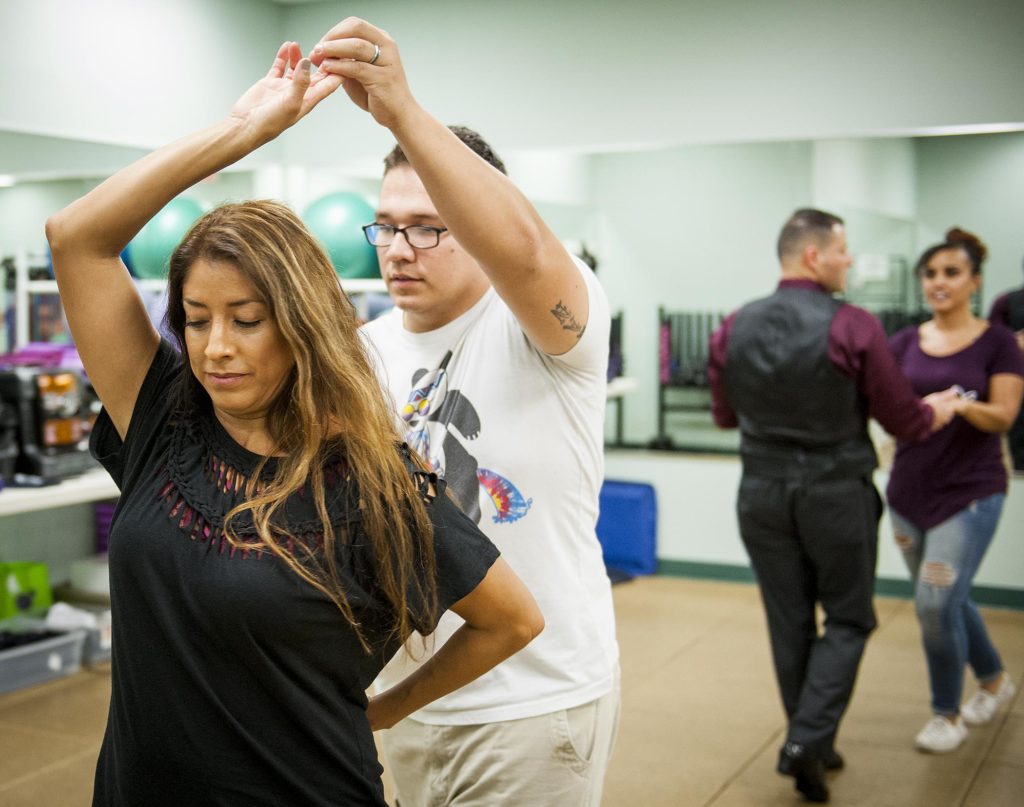
About 2 months ago, just before the coronavirus lockdown hit, we had the pleasure of attending our first salsa lesson at an event downtown.
Our daughter Melanie is a ballroom dancer, and with her coach, they ran a “pop-up” dance lesson at a local marketplace with around 30 people attending.
We learned some basic steps and then finally the big spin! One person asked a question, “what if you want to spin your partner multiple times” and the answer was simple “keep your hand in the air and just keep turning!”
This answer is also applicable to the question that the people had to St. Peter in the first reading today.
It was moments after Pentecost, the apostles had received the Holy Spirit, and St. Peter came outside to make this speech that we heard today.
The people realize their role in the passion and death of Christ and “they were cut to the heart” and asked Peter “What are we to do?”
And Peter could easily have answered with the words “just keep turning”.
The words he uses are “repent and be baptized…in the name of Jesus Christ for the forgiveness of sins and you will receive the gift of the Holy Spirit.”
The Greek word that Peter uses is “metanoeo” which means a radical turn of life away from sin and a new life oriented toward God.
The word is used 34 times in the New Testament and the word “to turn” is used even more in the Bible.
We recall from the book of Isaiah “Turn to me and be saved”, from John the Baptist “Repent for the kingdom of heaven is near” and from Christ himself “Repent and believe in the gospel”.
It is good to picture this in your mind as turning not only your head, but your entire body around toward God. (similar to a dance spin!)
I don’t know about you, but I find I need this lesson all the time and probably why the church tells us every Ash Wednesday to “turn away from sin and believe in the gospel”.
When do we need to turn? For many of us it is when we become self-reliant and can’t control things the way we want them.
- When our plans, vacations, renovations, etc. are delayed due to a pandemic and things get put off for a few months or longer
- When children or grandchildren struggle with schoolwork, friend situations, work stress
- When we have to put our plans on hold due to family emergencies
- When we can’t get what we want as our finances change unexpectantly
It is especially a challenge in countries like ours, Europe, etc. that are wealthy, as we can be very self-reliant as to at least our basic needs, and small inconveniences seem to bring us great stress.
This is a key lesson we can learn from the people in the poorest countries in the world. Whether it was the people of India, Uganda, Zimbabwe, or Bolivia; they seem to have a strong and relentless faith life as their lives truly depend on God’s graces and love each day.
They live lives that emulate the psalm we recited today and when you are with them you can almost feel how “even though they walk through the darkest valley, they fear no evil.”
They are always turning towards his face, and his voice, hearing the shepherd’s voice as he calls each of the sheep by their name. This intimate relationship between the sheep and shepherd is something that they turn toward and strive for as he “guides them on the right path.”
So how do we turn/spin/return to God? We don’t need grand gestures like walking the pilgrimage of Compestela for 30 days, but instead the little things every day
- As Pope Francis likes to remind us, reading 2-3 verses of the gospels and reflecting on them
- Saying the rosary even once a week that gives us 20 minutes of focus on Mary and life of Christ
- A quiet prayer time of 5-10 minutes where we listen more than talk
- Or a kind gesture, and act of kindness to another person to show them that God loves them through our actions
They don’t have to be perfectly executed ballroom dance turns, but ones done with enthusiasm, joy and love.
We can learn this lesson on our life’s journey, and it challenges us towards this constant turning back to God, and I believe the reason we celebrate Lent and Easter every year is this constant reminder from the book of Joel to “turn back to me with all your heart” and he will provide rest for our souls.
So, the homework for the week is to think about the how close we are to God – ask the question “what should we do?” and remember God’s answer is: “Just keep turning!”

Change – Fr. Mark

Third Sunday In Ordinary Time – Year B
Fr. Mark Gatto
Preached: Jan 21, 2018
Story of an elderly married couple. They had been married for 40 years. Every evening during their marriage they would sit and watch tv. Each of them sat in exactly the same two seats. Then one evening the husband turned to his wife and said, let’s change tonight, let’s do something really different. The wife was really excited imagining a night out on the town. Then the husband said, let’s change our seats. Sometimes I think a radical change in our church would be just to ask each of you to change your seat!
Change, something we do not like very much. We get very comfortable and want to keep everything the same. We were always this way so we do not want to bother trying to change how we are.
But Jesus, the very first message he preaches in Mark’s Gospel, Repent. Change. He is calling us to change. To turn around. To see things in a new way. The need to repent, to change, is necessary to embrace the Kingdom of God. Someone once said that a Saint is someone who has changed often. We as individual followers of Jesus and we as the Church need to be open and ready to repent, to change.
The prophet Jonah in our First Reading is sent by God to the great city of Nineveh, one of the great cities of the world at that time. He is to call them to repent, to change their way of life. The surprising thing is that they actually listen. The people of Nineveh repent, they see that their way of life was wrong and that they need to change.
The problem for us is that we do not like to change, we like to keep things the same, we get comfortable and it is easier to not change anything. Sometimes we feel that it is not possible for me to change. We get stuck or trapped in our old ways of living, old ways of behaving. That is the way I have always been, I cannot change.
Jesus says Repent and believe the Good News. Repentance and believing the Good News go together. The Good News is the salvation offered freely by God. The forgiveness of sins through the unconditional love, the gracious mercy of God. You do not need to remain stuck in your past, do not need to be remain trapped in your past sins, your past failings, your past bad decisions. A new future is possible. Change is possible.
Pope Francis is on a journey to Chile and Peru. Facing the issue of clergy sex abuse there. See the call for the church as a whole to repent, to face its failings and be ready to change.
There was one visit that I found very moving. The Pope went to visit a woman’s prison. For these women it was a wonderful joyful visit by the Pope to be remembered. They spoke about the mistakes they had made in their life to end up in prison. But, they felt hope that they could change, that they could have a new future. In the Pope they experienced God’s love, the Church’s care. They were believing that they could repent, that they could still have a new future in God’s grace.
Repent and Believe the Good News. Yes, you can change. You do not need to remain stuck in your past sins, your past mistakes, your past failings.