suffering
From Blindness to True Sight: Discovering God in Suffering
4th Sunday of Lent
Fr. Joonbin Lim
Preached: March 15, 2026
Today, through this Gospel, I would like to reflect on two things: first, what suffering is; and second, what it means to see.
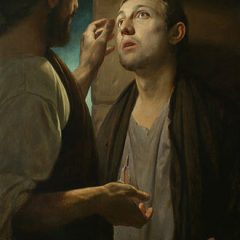
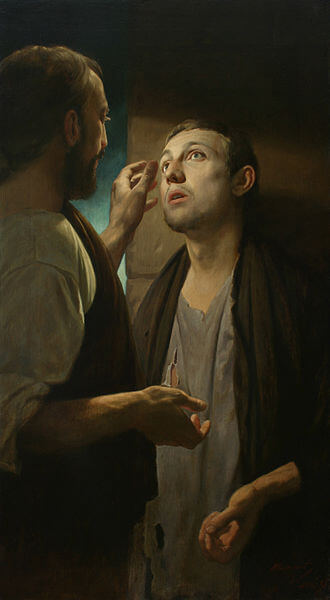
When we encounter someone who is sick or suffering, what is usually the first thought that comes to mind? For most people, it is probably the desire to help. But today’s Gospel begins with a very different question. People look at the man born blind, and before they notice his suffering, they ask, “Who sinned?”
In the thinking of many rabbis at that time, illness and disability were often understood as the result of sin. But Jesus rejects that way of seeing. He heals the man born blind, and because of this, conflict arises with the Pharisees and others among the Jews.
Their argument is clear: if Jesus healed on the Sabbath, then He broke the Law, and if He broke the Law, He cannot be the Messiah. Yet today’s Gospel invites us to go deeper.
What, then, is suffering? Like the man born blind, some people carry great suffering from the very beginning of life. And as we go through life, we encounter many kinds of suffering beyond our expectations and understanding: illness, loss, war, disaster, unjust tears, and pains that are difficult to explain.
In Buddhism, life is sometimes described as a sea of suffering. In a certain sense, we can understand why. We rarely see a baby born laughing. Every child enters the world crying. From the moment a child leaves the warmth of the mother’s womb and enters the world, that child has already entered the reality of suffering.
I have asked this question many times myself. When life becomes painful, when I face suffering I cannot understand, when innocent people die in war and disaster, I find myself asking: Why does God allow such things? Today’s Gospel gives us an important light.
Jesus says in John 9:3: “Neither this man nor his parents sinned; he was born blind so that the works of God might be revealed in him.” This does not mean that suffering itself is good, nor that God deliberately causes people to suffer.
Rather, Jesus rejects the idea that suffering is a sign of sin. He shows us that even in the place of suffering, the mercy of God and the work of salvation can be revealed. Just as darkness covered the deep before creation, the darkness of suffering still surrounds the human condition.
Humanity has long tried to explain its origin and meaning, but no myth, philosophy, or human wisdom has fully explained it. Yet light belongs entirely to God, and that light is revealed in the Word of God. God is not One who curses, crushes, or destroys us.
He is the One who seeks the suffering, embraces the wounded, and raises up those who are burdened and broken. In Jesus, we see the true face of God. In today’s Gospel, the man born blind and the Jewish authorities stand in sharp contrast.
The real blindness Jesus speaks of is not only physical. It is the blindness of those who claim to know and see, yet refuse to seek and accept the truth. The social assumption at that time was simple: if a man was born blind, he must remain blind, and therefore remain a sinner.
Because this belief was so strong, people could not even accept the reality of his healing. So in the end, the man born blind comes to see, while those who insist that they already see become the truly blind. This is spiritual blindness.
And this brings us to the second point: what does it mean to see? This Gospel is not simply the story of a blind man receiving physical sight. It asks all of us what it truly means to see. Usually, when we speak of seeing, we mean recognizing something with our eyes. But the seeing of which the Gospel speaks is much deeper than physical sight. It is not only noticing what is in front of us.
It is perceiving meaning, passing through life, and finally recognizing the truth. True seeing is not simply looking. It is seeing through experience. To see again means that something has been lived through from the depths of one’s being.
Often when we say we now see something differently, it is because we have suffered, endured, waited, and grown. The man born blind teaches us this. From the beginning of his life, he had more to endure than others. And often those who pass through many struggles come to see life more deeply. His receiving sight means more than physical healing.
By passing through the depth of suffering, he came to see the Lord anew. Our faith is like that. Faith is not simply looking at God from a distance. It is passing through life with Him. Through suffering, endurance, waiting, and grace, our eyes are opened.
And when we truly live, endure, and pass through life, we begin to see the Lord.

Mary Who Remained

Solemnity of Mary, Mother of God
Fr. Joonbin Lim
Preached: January 1, 2026
Scripture does not present the life of the Blessed Virgin Mary as a detailed biography; and yet, as we quietly follow the pages of the Bible, we come to realize that at every moment when God’s salvation begins, and at every place where it is brought to completion, Mary is always there.
We too often think of Mary only as a fully perfected saint, as someone w ho stands beyond pain and suffering; however, the Mary revealed to us in Scripture is, above all, a human being who stood before God in faith. She did not conceive Jesus according to her own wishes or plans, but at a certain moment her life was completely changed, not by her own choice, but by God’s call.
The angel’s greeting was indeed a blessing, yet at the same time it was a fear she could not fully understand and a responsibility she could not explain. Mary was asked to say “yes” without ever receiving an answer to the question, “Why me?” and that “yes” was not an emotional response, but a decision to place her entire life into God’s hands without knowing what lay ahead.
And that decision did not lead her onto a smooth or comfortable path, for her life unfolded through the birth in a manger, the flight as a refugee, the many moments when she did not understand her son, and finally, standing beneath the cross itself; her life became a long journey marked by loss, endurance, and quiet perseverance.
We remember her especially at the foot of the cross, where, as a mother, she had to watch her own son suffer and die, unable to do anything to stop it, a pain so deeply human that it defies all words. She did not demand a miracle, nor did she cry out for her son to be saved; she simply remained there, faithful to the end.
Brothers and sisters, this is the true greatness of Mary: not that she was spared suffering, but that she did not run away when she did not understand, and that she did not leave God even when she could not comprehend His ways.
This is precisely where our faith begins, for faith is not a certainty that comes after everything has been explained, but a choice to remain with God even in a reality that makes no sense to us. When we encounter unexplained pain, unwanted situations, and crosses we wish we could avoid, to remain there as Mary did, without fleeing, that is faith.
Mary does not promise us a life without suffering; instead, she teaches us that believing in God does not mean that suffering disappears, but that even in suffering, we are never alone.
Brothers and sisters, if there is an incomprehensible cross in your life today, that place is already a place where Mary once stood, and so let us pray that, like her, we may remain there to the end, trusting God even in silence.
Amen.

To the Empire’s Boundaries….And Beyond!

By http://www.moviestillsdb.com/movies/toy-story-3-i435761/20c11d67, Fair use, https://en.wikipedia.org/w/index.php?curid=44184427
2nd Sunday Of Lent – Year C
Fr. Peter Robinson
Luke 9:28-36
Do you remember the famed Buzz Lightyear and his battle cry in Toy Story? “To infinity and beyond” It’s funny, because there is no “beyond” beyond infinity, right? Now, I don’t often give titles to my homilies, but this one could be called: “To the Empire’s boundaries … and beyond”. Let me show you what I mean.
In our Gospel reading today, St. Luke stresses that Jesus went up the mountain to pray. Here is something interesting ⇢ Luke frequently stresses Jesus’ constant need for prayer. Jesus was a man whose life was permeated with prayer. In fact, when you think about it, many of Luke’s parables are about prayer
For instance, consider these examples …
Think of the poor widow, who keeps pleading with the unjust judge until she receives her request
Or the Pharisee and the tax-collector – because the Pharisee is filled with pride, God does not hear his prayer. And yet, the Pharisee is the religious conservative in this story — his theology is spot on. Whereas the tax-collector? — he is broken by the financial wrongs he has done to others, and God hears his prayer!
Prayer is important to St. Luke.
So, we find Jesus going up a mountain to pray. Then something absolutely extraordinary happens. While Jesus was praying his face changes in appearance, and his clothing becomes dazzling white. Then, Luke describes that Jesus converses with Moses and Elijah (two of the greatest OT figures). Moses represents the Old Testament law, and Elijah represents the prophets. They talk about Jesus’ coming journey up to Jerusalem. That journey will culminate in Holy Week, in which Jesus will offer himself as the Lamb of God, who takes away the sins of the world.
You see, a week earlier Jesus had said to his disciples: Truly I say to you, there are some standing here who will not taste death until they see the kingdom of God (v. 27). Now, a few privileged disciples get a precious glimpse of the eternal glory in which Jesus now dwells However, the three disciples also hear the voice of God insisting that they must listen to Jesus’ message
And what does Jesus teach them? He teaches them that suffering is the way to glory. He calls on them to give up their own lives in order to gain their lives. In other words, they are to take up their own crosses, and to follow him
Not only did the disciples struggle to hear this message, it is possible that (like us) they did not want to hear this message. That suffering and the cross … come before the glory. What I find amazing is how literally Jesus’ disciples came to believe this teaching (except for Judas, of course) … and how they put this message into practice.
Now, St. Peter and St. Paul gave their lives for Christ in Rome, in the very heart of the Roman Empire. Yet in the coming decades, the other Apostles would travel with the gospel to the edges of the Roman Empire … and even beyond. On those borders, as best we know, all of Jesus’ Apostles died a martyr’s death (except for St. John). They died on the edges of the Roman Empire — or beyond.
North, south, east and west … Jesus’ Apostles travelled with God’s message to their known world. To tell that world God’s message that Peter, James, and John had seen and heard on the Mount of Transfiguration. What was that message? This is my Son, my Chosen; listen to him!
………..
* See John Nolland, Luke 9:21–18:34 (vol. 35B; Word Biblical Commentary; Dallas: Word, Incorporated, 1993), 502
Genesis 15:5-12,17-18
Now, we have a graphic description of the kind of sacrifice that Jesus will make on the cross, from a story about Abraham in Genesis (15).
Our lectionary has deliberately paired these two stories together. Roughly 2000 years before the time of Christ, God made a pact with Abraham, of lasting protection for Abraham and his descendants. This pact (or covenant) was in the form of an ancient sacred sacrifice … a kind of rite known from other ancient Near Eastern sources, by the way (not just from the Bible)
The offerings of Abraham are cut in half, and (THIS IS IMPORTANT) it is God who makes the pact, by passing between the halves of the sacrifices. God uses this sacred symbol to declare his faithfulness to his covenant. God, Abraham — and his descendants — are now in a relationship that has serious and long-lasting consequences.
<[>You see, in the ancient Near Eastern world, such covenants were frequently made between two equals, or between overlord and vassal. But there is no historical record of such a covenant being made between a deity and a human being. Yet the awesome presence of God here passes between the halves of the offerings.
Notice that Abraham cannot impose conditions on God; God is the greater party. Nor can Abraham do anything to earn or justify this promise; the initiative is God’s. Abraham can only trust in God. For Abraham himself remains a nomad, with no settled territory to call his own
Notice, then, the similarity between Abraham’s sacrifice and the words you have spoken so often at the midpoint of the Mass. Just before the priest says the Prayer over the Offerings, he calls out: Pray, brothers and sisters, that my sacrifice and yours may be acceptable to God, the Almighty Father . And your response reflects the attitude of Abraham’s heart 4000 years ago: May the Lord accept the sacrifice at your hands for the praise and glory of his name, for our good and the good of all his holy Church.
This sacrifice of the Mass, this New Covenant (for us, the New Israel), if received in faith, like Abraham …
- Cleanses us of ALL our faults
- It makes us holy in body and mind
- And it is preparing us already for our celebration of Easter in mid-April
Suffering
12th Sunday Ordinay Time
Fr. Peter Robinson
Preached: June 23, 2024
Many years ago a war raged between the English and a local ruler in a region that the British Empire had colonized. During the course of that war, several English officers were taken prisoners, among them a young man named Baird. One day while in prison, the local ruler commanded that fetters (ie, iron chains) be put on each of the prisoners — including the wounded. The young man, Baird, had been severely wounded, and was suffering from pain and weakness.
A grey-haired officer, one of the British prisoners, said to the prison guard, “You’re not putting chains on that wounded young man, are you?” The prison guard replied, “I have my orders: there are as many pairs of chains as there are captives, and every pair must be worn.”
“If you do that,” replied the older British officer, “it will kill that young man. So, put two pairs of chains on me; I will wear his as well as my own.” The young man, Baird, lived to regain his freedom — but that generous, older officer died in prison.
Sadly, we are ALL familiar with suffering — we cannot know life without some measure of trials and pain. Sometimes (to be honest), we suffer due to our own fault. Sometimes we suffer due to someone else’s fault. But sometimes we suffer for no apparent reason at all.
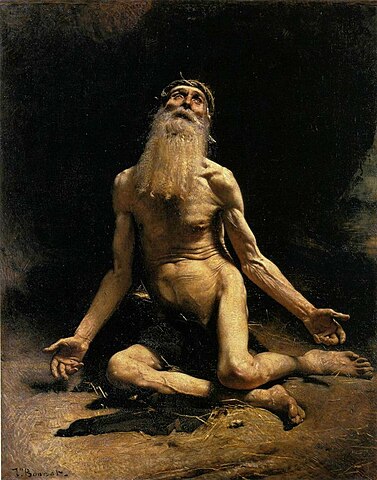
In today’s Old Testament Reading, we meet Job. He is presented as a righteous man, who experiences great suffering yet holds fast to his belief in his right standing. He had done no evil, no deliberate wrong. Yet, when suffering comes, even his friends insist that hidden sin is the reason for Job’s suffering.
How, then, do we face unexplained suffering, which can hit like a tsunami; even when we know that we did NOT do some act of evil; and even when our friends themselves blame us in some way? This is where we see the timeless wisdom of the Book of Job. It exposes the anguish of the suffering of innocent people. It exposes the incomprehension and frustration of all those who suffer undeservedly. Think for a moment: How many times has a parent cried out, “Why should my child die young?” Or how many times has a patient asked, “Why should I be subjected to long and humiliating illness?”
The character, Job, understands: he reaches a point in his suffering when he is so wound up that he curses the very day he was born. This makes the Book of Job so relevant to every generation: Job finds himself in a love-hate relationship with God. Throughout his suffering, he wants to be free of (what seems to be) God’s persecuting hand. Yet at the same time he depends on, and he is attached to, that same protecting hand. He doggedly remains confident that there is a solution — even though he may feel at times that God is bullying him. He remains convinced that God’s love will never forsake him.
So, we have these two conflicting emotions, seething together throughout the Book of Job: what seems to be God’s persecuting hand, and what seems to God’s protecting hand.
That is, until at the very end of the Book, Job has a vision of God. Here is where it gets fascinating: because God never explains to Job why he, as God, allowed Job’s suffering. Rather, he gives Job a vision of God’s incomparable wisdom. He gives Job a glimpse of God’s power over ALL of creation. By doing so, God convinces Job that his purposes are beyond human reasoning; and that Job has to trust God, has to take him at his word.
We close with this lesson for life: when God finally responds to Job’s cries, God emphasizes his total sovereignty, and Job chooses to acknowledge God’s sovereignty. This provides you and me with a template when we face suffering, doesn’t it? God IS fully in control of your circumstances, and he IS inviting you to acknowledge his loving, fatherly hand. This understanding brought calm to Job, it brought him comfort; just as it can calm and comfort you and me, too.
By the way, in due time God restored Job’s fortunes, but only after showing Job some of the glory of his divine person. As well, God restores Job’s fortunes only after showing Job more of Job’s own heart. When the time was right (from God’s point of view), he restored Job’s fortunes.
………..
* Paul Lee Tan, Encyclopedia of 7700 Illustrations: Signs of the Times (Garland, TX: Bible Communications, Inc., 1996), 1181.

Where Is Jesus – Fr. Mark

Fifth Sunday of Lent – Year B
Fr. Mark Gatto
Preached: Mar 18 2018
Jesus says, “where I am, there will my servant be also.” We are to be where Jesus is. So, where will we find Jesus today, in our world, in your life? A good examination of our conscience is to ask ourselves, where is Jesus today, where would Jesus be today?
Where will we find Jesus today?
- Parents – start at home, with your own children. Find Jesus there in them, including when they are difficult, when they are struggling, when they are having trouble at school, when you find them involved with drugs, be there for Jesus is there to bring healing, mercy.
- Grandparents – find Jesus in your grandchildren. Love and pray for them as Jesus with them.
- The Church, you and I, we need to find Jesus in the poor, the homeless, refugees, those struggling with mental illness, the lonely, the elderly, the sick, all those marginalized within our society for whatever reason. There is where we will find Jesus.
Now, what prevents us from going to be where Jesus is found? Jesus says, “those who love their life will lose it.” “unless a grain of wheat falls into the ground and dies, it remains just a single grain; but if it dies it bears much fruit.”
We desire a safe, comfortable life. So, fear is our greatest obstacle. Cowardice prevents us from going to be where Jesus is found. We prefer to go along with the crowd.
One of the results of giving in to fear is corruption. Corruption is present in so many areas of life, within so many institutions within our world. People are willing to cheat, to lie, in order to benefit themselves. Being successful is about being famous, wealthy, popular. It is achieved by defeating others by any means.
To be where Jesus is in our world today will require courage. To stand up against evil, to support those who face prejudice, to be on the side of the poor, the marginalized, those rejected by others. The courage to care about the most vulnerable in society even when it is not convenient. The poor, the unborn, the elderly, the terminally ill, those with disabilities.
All of us experience suffering in different ways. Suffering forces us to go deeper like the grain of wheat that must fall to the grain and die in order to bear fruit. But when we face suffering there are two different ways we can go deeper. We can go deeper in compassion and forgiveness or we can go deeper in anger and bitterness. Only by going deeper in compassion and forgiveness can bring us life.
In 2015 Pope Francis visited the Philippines. While there he was at a gathering of the youth. There he met a young 12 year old girl who tearfully recounted how she had spent her young life forced to forage for food from the garbage and to sleep outside on cardboard mats. She asked the Pope a simple but profound question. “Why did God let this happen to us?” Covering her face with her hands as she sobbed.
The Pope was deeply affected by her and put aside a text he had prepared for the occasion. Instead he responded directly to the young girl giving a reflection on the nature of suffering, love and service. He said to her “the nucleus of your question almost does not have a reply” Pain etched on his face as he mentioned that he had seen her tears. Then he said, “only when we too can cry about the things that you said are we able to come close to replying to that question.” “Why do children suffer.” “Certain realities in life we only see through eyes that are cleansed through our tears.” Pope Francis said.
Then he addressed the youth in the crowd, he could ask each of us here in this church, “I invite each one of you to ask yourselves: ‘Have I learned how to weep, how to cry when I see a hungry child, a child on the street who uses drugs, a homeless child, an abandoned child, an abused child, a child that society uses as a slave?” We need to learn to how to weep.
To be a Christian requires to be where Jesus is found. Jesus will be found where those most in need are found, in our homes, in our community, in our church. So, the church, you and I, must be there as well. Loving our life will cause us to avoid where Jesus is found today.
Fear, the desire for a safe and comfortable life, will keep us away. We need to be like the grain of wheat that falls to the ground and dies. We need to go deeper not in anger and bitterness, but deeper in compassion and forgiveness. We need to be able to cry when we see injustice, suffering, people hurting. Tears that lead us to be where Jesus will be found, bringing peace, healing, care.