30th Sunday Ordinary Tine
Fr. Joonbin Lim
Preached: October 25, 2026
When I was a child, I served as an altar boy and dreamed of becoming a priest. Believe it or not, I was quite popular with the girls in my school days. But back then, I thought, “I’m going to be a priest, so I shouldn’t have a girlfriend.”
Then, after finishing my military service and returning to university, I met a young woman. I liked her so much that I waited for her outside the university almost every day, hoping she would give me a chance. Eventually, we fell deeply in love and cared very much for each other.
But after I went to China to study, she ended our relationship. I never fully understood why. The pain of losing her was as deep as my love for her. I could hardly eat or sleep.
During that time, I thought deeply about love. Even when two people truly love each other, feelings can change. Sometimes, even when they want to stay together, they cannot. Even the deep love of parents for their children cannot prevent every hurt or fill every emptiness. Human love is precious and beautiful, but it also has its limits.
So I asked myself, “Where can I find a love that does not change—a love that embraces me with all my weaknesses?” As I prayed through that pain, I gradually became more aware of God’s love. When I was happy, he was there. When I was hurting and felt unable to do anything, he was still beside me.
I came to believe that God is the source of the perfect love I had been searching for. This did not make human love any less precious. Rather, I learned that God sustains our love and brings it to its fullness.
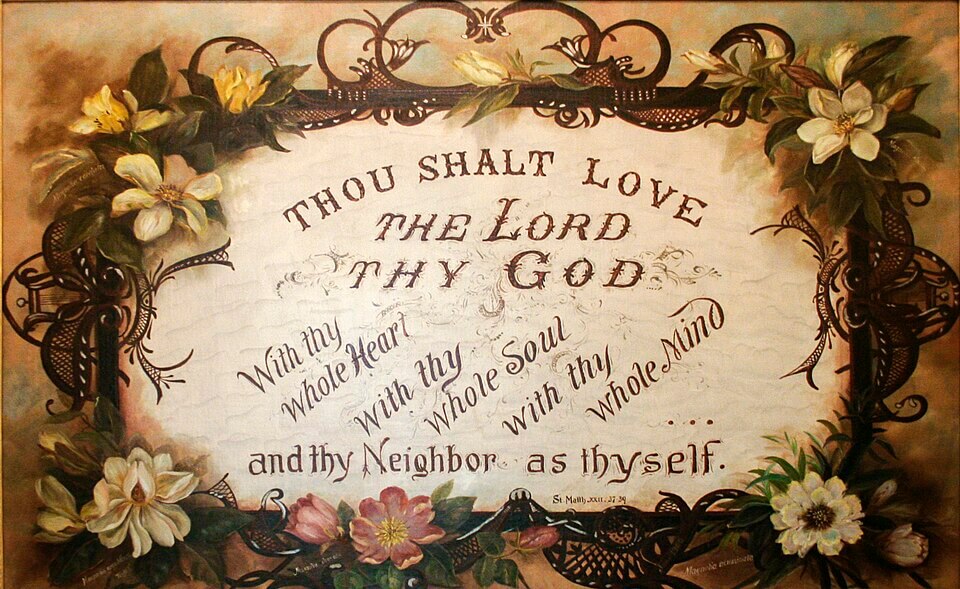
Today’s Gospel invites us to place that love at the centre of our lives. If we were to sum up the teaching of the whole Bible in two sentences, they would be the two commandments Jesus gives us today: “You shall love the Lord your God with all your heart, and with all your soul, and with all your mind.” And, “You shall love your neighbour as yourself.”
Jesus tells us that all the Law and the Prophets depend on these two commandments. The words are simple, but living them takes our whole lives. I once watched a documentary about a small Ethiopian Orthodox church high on a sheer cliff. To celebrate the liturgy there, the priest and the people had to risk their lives climbing a steep rock face. One wrong step could mean a fatal fall, so they had to give their full attention to every step.
Watching them made me think about what it means to give all our heart, all our soul, and all our mind. Meeting God mattered that much to them. We do not have to climb a cliff to meet God. But we are called to make time for prayer even when we are busy, to trust him when things do not go as we hoped, and to try to live according to his word.
And the hearts we open to God must also be open to our neighbours. The love we express in prayer must shape the way we treat people. That love cannot remain only a strong feeling or a good intention. It means continuing to value someone as time passes and circumstances change. Even when someone is no longer healthy or can no longer respond as we hope, we do not simply give up on them.
We can understand this by thinking about ourselves. We want to be respected despite our weaknesses and loved when we grow old or become ill. Even when we have nothing to offer, we hope someone will stay beside us. “Love your neighbour as yourself” is an invitation to offer others the love we hope to receive. It means taking the first step towards someone who needs our attention and care.
Of course, our love is imperfect, and sometimes we grow tired. That is why we return to the Lord, who loved us first. Jesus, who gave himself for us on the cross, fills us with his love here at this Mass. When I was younger, I asked, “Where can I find perfect love?” Now, as someone who has received that love, I want to ask, “Who can I share that love with today?”
Let us all carry that question in our hearts—and show that love to one person today.