Corpus Christi
Real Versus Virtual Community
Solemnity of the Most Holy Body and Blood of Christ
Fr. Mark Gatto
Preached: June 7, 2026
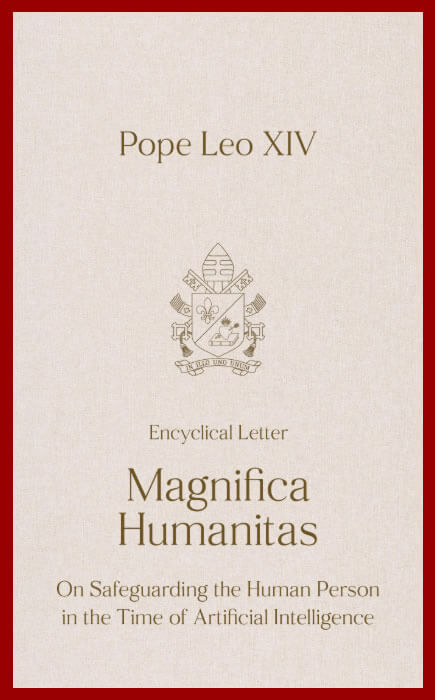
Pope Leo just published his first encyclical. Called Magnifica Humanitas, “magnificent humanity.” It reflects on Artificial Intelligence. Why would the Pope write an encyclical on Artificial Intelligence? It does not seem like something very spiritual or catholic.
Yet, it is something deeply spiritual and very catholic because it is about humanity. Pope John Paul II once defined Christianity as “an attitude of amazement at the dignity of the human being.” Christianity is not an idea, it is not a philosophy, it is not an ideology. It is about a person, Jesus Christ. It is an encounter with this person, Jesus Christ.
The Feast of Corpus Christi, the Body and Blood of Christ, reveals this very clearly. In John’s Gospel, Jesus calls himself “the living bread.” He says we must “eat the flesh of the Son of Man and drink his blood.” Very strong language. It is about embracing this person, becoming intimately united with this person.
Christianity is not about reading a book and learning things, it is not about some spiritual life away from the real world. It is about a real human encounter with the person of Jesus. It is about being fully alive as a human being in the midst of this world.
The foundation of Catholic social teaching is the dignity of the human being. The Pope has chosen to write about Artificial Intelligence because he sees some of the dangers we face. There are some who want us to move beyond humanity, to some sort of trans-humanism.
There is danger that we lose some fundamental things that respect human dignity. To be human is not to be completely independent and solitary. It requires communion, to be in community, to be engaged with others. The danger of social media and artificial intelligence is that we live in a virtual community and not a real community. We stay in our room by ourselves being virtually connected with others. It makes it easy to ignore the suffering of real human beings or of our planet.
The Feast of Corpus Christi leads us to encounter God in a real human way. We receive and eat Jesus, the bread of life. It is not just some spiritual encounter in the clouds. It is the real presence with a real group of people. We come to a church to celebrate the Eucharist, and we are here with people of different ages, different cultures, different languages, different ways of thinking.
It might be nice to be with a homogenous group of people who are all like me and think like me. But, the Eucharist is a fully human encounter with the living God and with the body of Christ in the church.
Christianity is not an idea or philosophy, not just reading a book. It is about touching, seeing, encountering the living God. The dignity of human beings should influence all we do. So, the Pope in writing on Artificial Intelligence is following in the great tradition of Catholic social teaching that is focused on human dignity and protecting human dignity.
Anything that lessens human dignity needs to be reformed. War and peace, political systems, economic systems, technology, all need to be seen in light of what the impact is on human dignity. We eat the bread of life, God meeting us as a human being in Jesus. We meet God then in each human being.
In his Encyclical on Artificial Intelligence, the Pope also gives us one very practical way of living out what he is discussing. Simple rituals like hosting family and or friends for a dinner. This is so human. In fact, the way Jesus left us to pray as a church is the Eucharist, a sacred meal. When you have a meal with family or friends, it is something very Christian because it is something very human. A study I saw years ago showed that teenagers in families that share meals together regularly do better in every aspect of life.
I encourage some of you to read the encyclical of Pope Leo, it provides a good summary of Catholic social teaching and is a good reflection on the future of our world impacted by Artificial Intelligence. Some simple practices that you can do in response, invite family or friends for a dinner. Come regularly to this Sacred Meal of the Eucharist and encounter the flesh of Jesus, the bread of life. Live real community versus virtual community.

It’s Just Not The Same!
Feast of Corpus Christi
Deacon Tom Vert
Preached: June 14, 2020
It’s just not the same!
I remember my father years ago saying this to me. He was diagnosed with high cholesterol and the doctor told him to cut back on the salami and start eating light cheese instead of regular cheese. He told me its’ just not the same (and truth be told a bit like rubber!)
Another example is during this past three months, people have gone to the hospital for procedures and there have been no visitors allowed. Phone calls a few times a day are allowed, but the daily visit, bringing in a favourite food, or magazine or just a more frequent fluffing of the pillow are not allowed – its just not the same!
And of course there is the Zoom or Google Meets or FaceTime video to the children, grandchildren, relatives and/or friends that we have now all learned to log onto – it doesn’t replace the hug, the kiss on the scraped knee, the spray with the garden hose or just a simple high five – it’s just not the same.
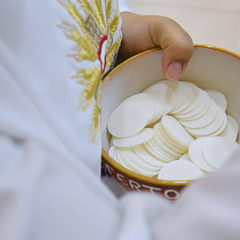
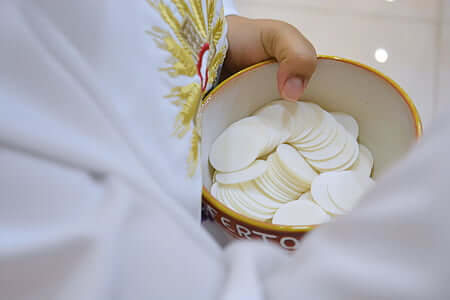
And finally, the online mass, the “virtual” Eucharist, the television Sunday church – it doesn’t give the smell of incense, the sound of voices singing together (some good and some not so much, but all with full heart), the sign of peace and of course as we celebrate the feast of Corpus Christi today – the touch and taste of the Eucharist – the real presence of Christ transformed as a mystery by the Holy Spirit through the Eucharistic prayer.
Virtual, simulated, artificial, imitation, etc. – all are okay as temporary measures, but real, authentic and true celebration of the mass and the Eucharist is when we are all together as a community of faith!!
This is why I am so excited for next Sunday’s mass, even if at 30% attendance, it is much better than <1%!
Isn’t this what St. Paul is telling the Corinthians in the 2nd reading: “Because the loaf of bread is one, we, though many, are one body, for we all partake of the one loaf.”
We are the Body of Christ – the loaf shared together here at mass, and then sent out with the nourishment of Jesus in our bodies to be the Body of Christ in the world each day.
In Corinth, the participation in the Eucharist, the Lords supper, was the defining moment of the action of believers as a community. This defined them as Christians; the ones who were sharing the cup and the bread.
Paul reinforces this with them by two questions:
‘The cup of blessing that we bless, is it not a participation in the blood of Christ?
The bread that we break, is it not a participation in the body of Christ?”
Christian unity is grounded in sharing the loaf; the participation in the mass, enables and energizes the participation in spreading God’s love in daily life.
In Paul’s time, sharing the table, dining with a group was the primary social symbol of acceptance, of belonging, and of mutuality. With the Lord’s Supper as the feast, this was the key component of the Christians, as opposed to others who sacrificed to their own gods and then brought the food to a personal festival.
When we are together at mass, we are to see the Eucharist in this light – as a special time together, where we are partakers with Christ himself present, not a symbol, not virtual, not a simulation, but the real presence of Christ in our midst.
In the gospel we see the people of the time also had a hard time in understanding what Christ was trying to tell them. What is he saying to eat his flesh and drink his blood? It was one of the most difficult passages of the gospel – then and now!
The people of the time though would have understood that when a sacrifice was given at the temple; a small part was for burning, another part for the priests, and the rest for the worshippers to eat. Since it was a ritual sacrifice, it was God who was present and therefore, people left the meal God filled.
It was not meant to be literal – it is a way to be in spiritual union with their Israelite God.
Eat my flesh and drink my blood really means for us to become Christ like – inside and out. He tells us to “Remain in me”, therefore, his word, actions, how he related to others, and his example are the blood and body we are to consume and use as spiritual food for our life.
Blood means life – Jews will not eat anything not drained of blood – but Christ says to drink his blood and attain life – he is our full need and eating of him brings us life to the fullest.
The Jews brought up the manna from heaven from their past and Jesus says that it was temporary, good for one day; but true living bread was himself – if we follow him and eat of his life, then we gain eternal life through his graceful gift.
His saving work of redemption and sacrificing himself is what gives eternal life.
Participating in the Eucharist, thereby, participates in Christ’s life itself.
When we receive the Body of Christ in our hands for the first time in many months, lets us thank God for His presence and remind ourselves that “It’s just not the same!”