Solemnity of the Most Holy Body and Blood of Christ
Fr. Mark Gatto
Preached: June 7, 2026
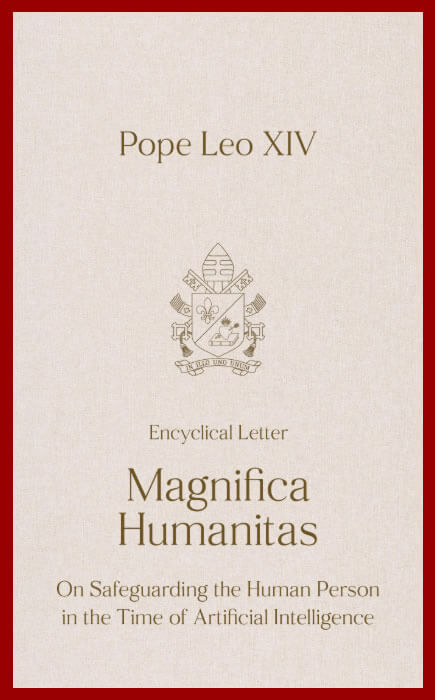
Pope Leo just published his first encyclical. Called Magnifica Humanitas, “magnificent humanity.” It reflects on Artificial Intelligence. Why would the Pope write an encyclical on Artificial Intelligence? It does not seem like something very spiritual or catholic.
Yet, it is something deeply spiritual and very catholic because it is about humanity. Pope John Paul II once defined Christianity as “an attitude of amazement at the dignity of the human being.” Christianity is not an idea, it is not a philosophy, it is not an ideology. It is about a person, Jesus Christ. It is an encounter with this person, Jesus Christ.
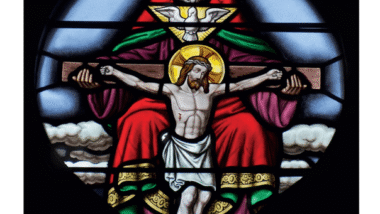
The Feast of Corpus Christi, the Body and Blood of Christ, reveals this very clearly. In John’s Gospel, Jesus calls himself “the living bread.” He says we must “eat the flesh of the Son of Man and drink his blood.” Very strong language. It is about embracing this person, becoming intimately united with this person.
Christianity is not about reading a book and learning things, it is not about some spiritual life away from the real world. It is about a real human encounter with the person of Jesus. It is about being fully alive as a human being in the midst of this world.
The foundation of Catholic social teaching is the dignity of the human being. The Pope has chosen to write about Artificial Intelligence because he sees some of the dangers we face. There are some who want us to move beyond humanity, to some sort of trans-humanism.
There is danger that we lose some fundamental things that respect human dignity. To be human is not to be completely independent and solitary. It requires communion, to be in community, to be engaged with others. The danger of social media and artificial intelligence is that we live in a virtual community and not a real community. We stay in our room by ourselves being virtually connected with others. It makes it easy to ignore the suffering of real human beings or of our planet.
The Feast of Corpus Christi leads us to encounter God in a real human way. We receive and eat Jesus, the bread of life. It is not just some spiritual encounter in the clouds. It is the real presence with a real group of people. We come to a church to celebrate the Eucharist, and we are here with people of different ages, different cultures, different languages, different ways of thinking.
It might be nice to be with a homogenous group of people who are all like me and think like me. But, the Eucharist is a fully human encounter with the living God and with the body of Christ in the church.
Christianity is not an idea or philosophy, not just reading a book. It is about touching, seeing, encountering the living God. The dignity of human beings should influence all we do. So, the Pope in writing on Artificial Intelligence is following in the great tradition of Catholic social teaching that is focused on human dignity and protecting human dignity.
Anything that lessens human dignity needs to be reformed. War and peace, political systems, economic systems, technology, all need to be seen in light of what the impact is on human dignity. We eat the bread of life, God meeting us as a human being in Jesus. We meet God then in each human being.
In his Encyclical on Artificial Intelligence, the Pope also gives us one very practical way of living out what he is discussing. Simple rituals like hosting family and or friends for a dinner. This is so human. In fact, the way Jesus left us to pray as a church is the Eucharist, a sacred meal. When you have a meal with family or friends, it is something very Christian because it is something very human. A study I saw years ago showed that teenagers in families that share meals together regularly do better in every aspect of life.
I encourage some of you to read the encyclical of Pope Leo, it provides a good summary of Catholic social teaching and is a good reflection on the future of our world impacted by Artificial Intelligence. Some simple practices that you can do in response, invite family or friends for a dinner. Come regularly to this Sacred Meal of the Eucharist and encounter the flesh of Jesus, the bread of life. Live real community versus virtual community.