human dignity
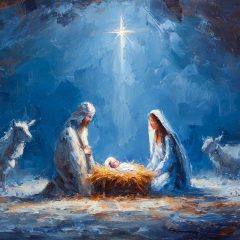
I Am With You: A Christmas Reflection on Dignity and Presence

Christmas Day 2025 – Year A
Fr. Joonbin Lim
Preached: December 25, 2025
On Monday, I was on my way back from visiting the Korean Consulate in Toronto. As I got off the train and was heading toward the subway station, I encountered a homeless man. Normally, I might have passed by without stopping, but that day the cold was especially severe. He was wearing only very thin clothing and seemed to be enduring the cold with his whole body. I happened to be wearing an extra light jacket under my coat, and after a brief hesitation, I took it off and gave it to him.
In that moment, the hearts of Joseph and Mary came to mind—wandering without a place to stay, searching for shelter. Their journey, unable to find a home and moving through unfamiliar places, closely resembles the hearts of so many people today who are lonely, wounded, and vulnerable. That day, I found myself reflecting deeply on what it means to be truly human and on the meaning of dignity. We are all born equal in our humanity, yet some live in conditions so harsh that even speaking about human dignity seems painfully difficult.
On the way home, I reflected on myself as well. Living as a foreigner, I sometimes feel like a child. In unfamiliar places, I have to ask others for directions, and because English is not fully comfortable for me, there are moments when I misunderstand or struggle to follow conversations. At times, I feel powerless—like someone who cannot even speak properly without a small homily text in hand, a fragile and vulnerable person. In truth, without your prayers and support, I could not have lived in Canada, nor could I continue my ministry as a priest. When Christmas comes, I do not really have another place to go. The church is my home, and the rectory is where my life unfolds.
The word “Christmas” comes from Christ and Mass. The word “Mass” is derived from the Latin “Missa” meaning “to send” or “to commission.” Therefore, Christmas is not simply a day we remember or celebrate, but the celebration of the sending of Christ. It is the day when God sent His Word—the Logos—from heaven into this world, not as a distant God, but as One who comes close to us.
He was born in a dark and cold place, not in power and glory, but as a helpless infant. Why did God choose to come as a child? Perhaps it was so that, through Him, we might realize that we too are capable of doing something for others. Perhaps it was so that the love God has already placed within us might naturally flow out as we look upon Him in His weakness and vulnerability. Had Jesus come in overwhelming power, we might have done nothing more than ask from Him, rather than learn how to love.
In Scripture, “nakedness” signifies being unprotected and powerless. A naked infant cannot survive without care; such a child depends entirely on parents and on the help of others. This is the very image of our humanity—a people who need one another, who must accept their own weakness, and who can only truly live by sharing life with others and by embracing the weakness of one another. God became human to help us understand this truth.
As we celebrate Christmas, the Lord approaches silently those who are weary, those who are lonely, and those who feel they have nowhere to go. He comes to them with a simple message: “I am with you.” This is the gift of Christmas.
And so, Christmas is not merely about remembering an event from the past. It is an invitation for us, as people of faith, to ask ourselves how we are living now, and in what direction we are being called to move in the future.

The Church And Human Dignity
Feast of Sts. Peter and Paul
Fr. Mark Gatto
Preached: June 29, 2025
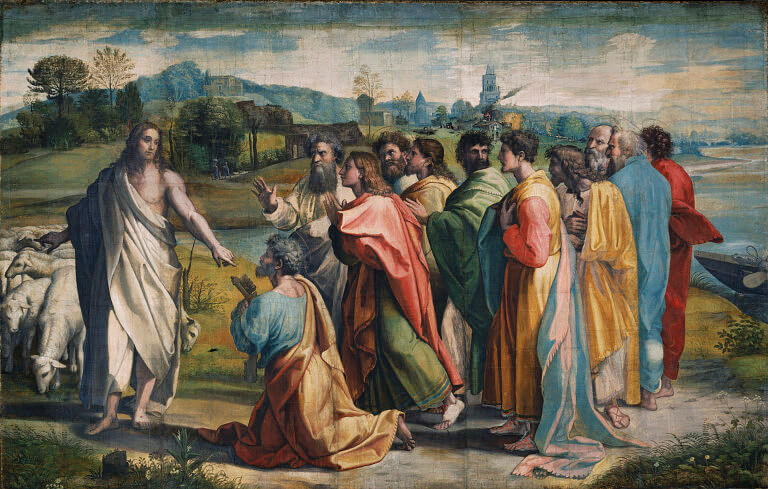
“On this rock I will build my Church.” The plan of God, the plan revealed in Jesus, included the Church. Two of the great figures who were crucial to the initial building of the Church were Peter and Paul. These two great figures who began what we continue today. In the readings for this Feast we hear of Paul as one who proclaimed the Gospel to the Gentiles and who finished the race and kept the faith. Jesus calls Simon and names him Peter, the rock upon which he will build his Church.
The Church today continues to keep the memory of God alive in our world. But, perhaps more important than ever, the Church is called to work to protect human dignity. We are in the world, where once again war and weapons are the path we human beings are choosing. God is not on any side in these wars. God is only on the side of the many children being killed or suffering. God is on the side of the young soldiers required to fight in these wars which are the failure of leaders. In these wars, the dignity of human beings is ignored, the dignity of the human beings on the other side is not recognized.
The Church must be a body that defends all human dignity. God entered our human reality and so the Gospel message clearly reveals the great dignity of human beings. But, we easily forget or ignore the dignity of human beings who are not on our side.
Pope Leo speaks often about the dangers of Artificial Intelligence. This issue is also about human dignity. Robots, machines, algorithms, these cannot take the place of basic human dignity.
During my recent trip to Europe I went to the city of Turin. While there I prayed at the chapel where the Shroud of Turin is kept. There I saw a prayer which I really liked.
“O God our Father, the figure of the Shroud sends us back to the sufferings inflicted on your Son, Jesus, who has taken on himself the sorrows of every human being. Help us to see Him in every person, …”
If we are going to be near to Jesus, if we are going to know Jesus, we need to see Jesus in every person. We need to care for Jesus in each person. The dignity of the human being is the heart of the Gospel and a mission of the Church today is to protect human dignity.
The Mass is the primary way that we the Church assemble together. The Mass is quietly very valuable in protecting human dignity. For many of us it is the one hour when we are not focused on our cell phones and social media. It is the one time when we are together with people of all ages, from seniors in their 90’s to little babies. Teenagers, young adults and middle ages. It is the one time when we are together with people of all different races and cultures. It is a time when rich and poor and people of different backgrounds are together.
This Mass is the way that the Church that Jesus began to build on the rock of Peter and in the Apostle Paul continues to be visible in our world today. The Mass builds up the Church and it leads us to recognize our own human dignity and the dignity of all human beings.
Jesus had a plan for a Church which would be built on the rock of Simon Peter. It is the Church that we continue to build up today. In the Mass this Church is made visible. This Church is th plan of Jesus to keep the Gospel alive, to remind the world of the fundamental dignity of human beings.

God Has Spoken

Christmas 2020
Fr. Mark Gatto
Posted: December 25, 2020
Luke describes a vision of shepherds going in haste to see something special. A multitude of Angels were praising God singing, “Glory to God in the highest heaven,…” It all seems like such a wonderful, magical moment. But, what we see is such a simple, ordinary and very human scene. A mother, a father and a weak new born baby.
The Word became flesh. A child was born among us wrapped in swaddling clothes. In this little baby, the God of the universe, the God who is beyond all and embraces all, wanted to speak to humanity. God entered our history and time, became one of us, to speak a word to us.
So, we speak of Jesus as the Word of God and sometimes speak of Jesus as the face of God.
The invisible God was made visible in our midst.
In Jesus, the Word made flesh, what has God spoken to humanity? Here are a few words that capture some of the ultimate Word that God spoke to us in the coming of Jesus:
Love. That God is love and that we are loved by this God and that we are all called to live a life of love. We are all connected in a love beyond anything we can imagine. Wherever there is true love in this life, we are connected to God. It is love that keeps us connected to those who have died and gone before us. Love and connection is the foundation and basis of our universe. God’s Word is a word of love.
Human dignity. St. John Paul II once described Christianity as “an attitude of amazement at the dignity of the human being.” We need to recognize our own dignity, each one of us has a dignity rooted in God. Therefore, we need to treat each person in this life with a sense of their dignity. The homeless, the poor, those of other religions or no religion, each member of our family, each friend and each stranger. The dignity of each human being should be the guide to every decision we make politically, economically, personally. How we respond to refugees, to people of other nations and to each neighbour. God’s Word reveals our human dignity.
Forgiveness. So much guilt can afflict us, but God has spoken a word of forgiveness. God is so generous in offering forgiveness. God is extreme, even seeming foolish in offering forgiveness. God wants to overcome evil, not by force or violence, but by wiping it out through forgiveness.
This should lead us to make forgiveness the heart of our way of life, our spirituality. In fact, we recognize that call to forgiveness, in order to be like God, each time we pray the Lord’s Prayer. God’s Word says to us, “I forgive you.”
Poor. The rich and the powerful and the famous are not worth more than the poor, the weak, the unknown. God sees beyond all of our world’s ways of judging. God did not come as a powerful force to dominate and control the world. God came as a poor little baby with no power at all. For the God of the universe does not desire to control us but to set us free. God’s Word is a word to the poor, including the poverty in each one of us.
The final word that I will use today that captures something of that Word of God spoken in Jesus, is the word, Kind. This is a God who is everlasting kindness. When we are kind, we are being like God. When I decided to become a priest, my father only had one piece of advice, “be kind to the people.” It seemed so simplistic. Yet, the choice to be kind makes a big difference in our world.
Think about your own experience. During your day, when one person shows you kindness how does that make you feel? But, if one person shows you unkindness during the day, how does that make you feel? A kind word or a kind act can make such a difference.
God’s Word is a word that says, Be Kind.
In Jesus, the Word of God, our God has spoken to humanity. The words I shared here capture some of what God wanted to say to us. Take some time to think about what other words you would include in this story. Someone once asked, “what is the most valuable prayer of Christmas?” His answer was, that the most valuable prayer of Christmas is Silence.
This Christmas, take a moment of silence, listen in your heart to the word God has spoken in Jesus and listen within for the word spoken to you.