6th Sunday Of Easter
Deacon Tom Vert
Preached: May 25, 2024
“Who are we?” “What do we stand for?” “What do we believe?”
In the first reading for the last six weeks, we have been watching the early church try and find its way after Jesus’ ascension and the descent of the Holy Spirit at Pentecost. The Acts of the Apostles is truly like an action series on TV and would be #1 rated if it was shown in the modern world.
From the point of Pentecost forward we see incredible action:
- Conversion of St. Paul from persecutor to evangelist/apostle travelling the world spreading the gospel message
- St. Peter travelling to Syria and Rome
- St. Thomas to India
- St. Mark to Egypt founding the church at Alexandria
- St. John in Turkey and St. Andrew in Greece
The church is spreading like wildfire, and it was hard to keep the gospel message consistent across all these territories and communication by handwritten letters that make take weeks or months to deliver. There was no Bible with nothing written down to start as they expected Jesus back at any moment.
As the realized that Jesus might not come back, the 4 gospels were written around 70 – 95AD and at the same time the letters to the early Christian churches. St. Paul sent the NT letters to try and help the communities that he founded with corrections to rogue teachers, infighting among Christian leaders, how to live as a church and more.
In today’s first reading, we see the problem of the Gentiles for the early believers. The Holy Spirit was converting gentiles to the faith both through St. Paul and St. Peter. How were they to act? Like Jews or gentiles or a mix? There was a lot of debate, so how did they reconcile it…the called the first council/synod in Jerusalem. They listened to the Holy Spirit, and he told them the answer to accept the gentiles as full members and not burden them with all the Jewish practices.
As these saints died, the next generation of bishops took their place trying to keep the message consistent, but you know how it is with the “telephone tag” problem. This pace of change continued over the first 3 centuries as the church and its members were being persecuted by the Romans.
On top of all this, they had to try and figure out what they truly believed and how to communicate it? Who were they? A group of slightly different Jewish people? A totally new faith? An evolution? Was the OT now void? Or was it a prediction of Christ himself? Did they still have One God alone as their Jewish converts would think, or did they have three Gods like their Greek converts might think, or how were they to communicate the Triune God of the Father, Son and Holy Spirit? What we take for granted now as the Trinity, was a major battle back then!
Over this time people started to come out with misleading theories about the faith that we call heresies – controversies – trying to figure it out! Some say Jesus only appeared human, but he wasn’t. Some said Jesus was the best human only but not the Son of God.
Finally in the early 300’s we had a major controversy that was splitting the church and led by a priest named Arius. He argued with his followers that the Son was different from the Father; he was not God but created and not begotten or of the same essence, therefore the was no Trinity.
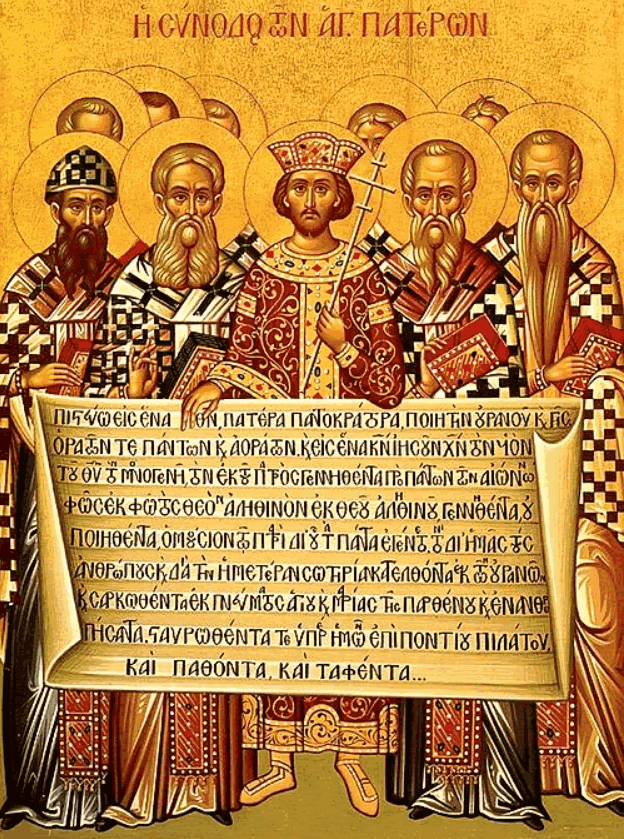
So, to bring the church back to unity, the emperor Constantine, called a Synod or Council at Nicaea, 1700 years ago this week. He called the council to bring back unity and not division, to clarify and not confuse and to have the church move forward as one entity proclaiming the Gospel message!
1700 years ago, they clarified that:
- Christianity is different from Judaism.
- The approved books of the Bible were defined.
- The Trinity and Jesus as God and Son of God was proclaimed
The Bishops answered those key questions: “Who are we?” “What do we stand for?” “What do we believe?” We owe them a great debt of gratitude, as the summary of their work is still with us in
the Nicene Creed that we recite.
Normally at our masses we recite the Apostles Creed, which is older than the Nicene, written around 150AD, but it is not as accurate to answer the questions that the different parts of the church had including the followers of Arius.
The great part of the Nicene Creed is that it is a symbol of unity to this day as it is recognized as the core of the faith by the Roman Catholic Church, the Orthodox churches, the Eastern Rite churches, the Lutherans, Presbyterians and most major Christian churches.
It is critical as it is the common foundation that we can talk with the other churches as Christians and proclaim a common message even though we have different liturgical practices.
Pope Leo XIV has already talked about this goal of peace and unity and walking with our fellow Christians on the journey of faith. He has said three key messages already in the spirit of Nicaea:
1. The pursuit of full and visible communion of all Christians is one of his priorities.
2. The importance of synodality, and in “promoting the synodal character of the Catholic Church,” in the spirit of Jerusalem and Nicaea.
3. The “growing commitment to dialogue and fraternity” that marks relations between the Catholic Church and other non-Christian faiths as “a solid basis for building bridges between our communities.”
This week we commemorate the fathers of our faith who gave us clarity for the questions:
“Who are we?” “What do we stand for?” “What do we believe?”
So, in celebration of the anniversary of Nicaea 1700 years ago, I would ask you all to
stand, open our CBW books to the back cover, and let us recite this great symbol of our
faith together.
Nicene Creed: (381AD)
We believe in one God,
the Father, the Almighty
maker of heaven and earth,
of all that is, seen and unseen.
We believe in one Lord, Jesus Christ,
the only Son of God,
eternally begotten of the Father,
God from God, Light from Light,
true God from true God,
begotten, not made,
of one Being with the Father.
Through him all things were made.
For us men and for our salvation
he came down from heaven:
by the power of the Holy Spirit
he became incarnate from the Virgin Mary, and was made man.
For our sake he was crucified under Pontius Pilate;
he suffered death and was buried.
On the third day he rose again
in accordance with the Scriptures;
he ascended into heaven
and is seated at the right hand of the Father.
He will come again in glory to judge the living and the dead,
and his kingdom will have no end.
We believe in the Holy Spirit, the Lord, the giver of Life,
who proceeds from the Father and the Son.
With the Father and the Son he is worshipped and glorified.
He has spoken through the Prophets.
We believe in one holy catholic and apostolic Church.
We acknowledge one baptism for the forgiveness of sins.
We look for the resurrection of the dead,
and the life of the world to come. Amen.