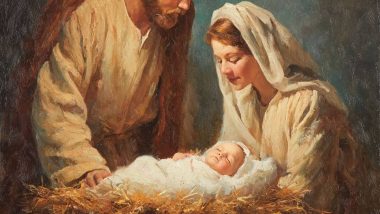
Christmas Day 2025 – Year A
Fr. Joonbin Lim
Preached: December 25, 2025
On Monday, I was on my way back from visiting the Korean Consulate in Toronto. As I got off the train and was heading toward the subway station, I encountered a homeless man. Normally, I might have passed by without stopping, but that day the cold was especially severe. He was wearing only very thin clothing and seemed to be enduring the cold with his whole body. I happened to be wearing an extra light jacket under my coat, and after a brief hesitation, I took it off and gave it to him.
In that moment, the hearts of Joseph and Mary came to mind—wandering without a place to stay, searching for shelter. Their journey, unable to find a home and moving through unfamiliar places, closely resembles the hearts of so many people today who are lonely, wounded, and vulnerable. That day, I found myself reflecting deeply on what it means to be truly human and on the meaning of dignity. We are all born equal in our humanity, yet some live in conditions so harsh that even speaking about human dignity seems painfully difficult.
On the way home, I reflected on myself as well. Living as a foreigner, I sometimes feel like a child. In unfamiliar places, I have to ask others for directions, and because English is not fully comfortable for me, there are moments when I misunderstand or struggle to follow conversations. At times, I feel powerless—like someone who cannot even speak properly without a small homily text in hand, a fragile and vulnerable person. In truth, without your prayers and support, I could not have lived in Canada, nor could I continue my ministry as a priest. When Christmas comes, I do not really have another place to go. The church is my home, and the rectory is where my life unfolds.
The word “Christmas” comes from Christ and Mass. The word “Mass” is derived from the Latin “Missa” meaning “to send” or “to commission.” Therefore, Christmas is not simply a day we remember or celebrate, but the celebration of the sending of Christ. It is the day when God sent His Word—the Logos—from heaven into this world, not as a distant God, but as One who comes close to us.
He was born in a dark and cold place, not in power and glory, but as a helpless infant. Why did God choose to come as a child? Perhaps it was so that, through Him, we might realize that we too are capable of doing something for others. Perhaps it was so that the love God has already placed within us might naturally flow out as we look upon Him in His weakness and vulnerability. Had Jesus come in overwhelming power, we might have done nothing more than ask from Him, rather than learn how to love.
In Scripture, “nakedness” signifies being unprotected and powerless. A naked infant cannot survive without care; such a child depends entirely on parents and on the help of others. This is the very image of our humanity—a people who need one another, who must accept their own weakness, and who can only truly live by sharing life with others and by embracing the weakness of one another. God became human to help us understand this truth.
As we celebrate Christmas, the Lord approaches silently those who are weary, those who are lonely, and those who feel they have nowhere to go. He comes to them with a simple message: “I am with you.” This is the gift of Christmas.
And so, Christmas is not merely about remembering an event from the past. It is an invitation for us, as people of faith, to ask ourselves how we are living now, and in what direction we are being called to move in the future.